If you’re searching for massage Shepparton because your neck and shoulders are constantly tight — this is for you.
Neck and shoulder pain is one of the most common complaints people bring to treatment.
It’s also one of the most misunderstood.
Most people assume it’s just tension.
Something that will ease up with rest.
But it doesn’t ease up.
It comes back.
Every morning.
Every afternoon.
Often worse by the end of the week.
This guide explains what’s actually driving it.
And what targetedtreatment can do to fix it.

Why Neck and Shoulder Pain Builds Up
Neck and shoulder pain rarely has a single cause.
It builds from a combination of factors.
Most of them are part of everyday life.
The most common causes:
- Desk work and screen time — the head weighs around 5kg. Every degree it tilts forward multiplies that load on the neck.
- Driving — sustained gripping of the steering wheel and a fixed head position creates tension through the upper trapezius and neck extensors.
- Phone use — looking down at a screen for extended periods loads the cervical spine and shortens the muscles at the back of the neck.
- Stress and anxiety — the body’s stress response causes the shoulders to rise and the neck muscles to brace. Over time, this becomes a default holding pattern.
- Sleeping position — the wrong pillow height or sleeping on the stomach rotates the neck for hours at a time.
- One-sided movement — trades, manual work, or sport that repeatedly loads one side creates muscular imbalance.
👉 The problem with most of these causes is that they happen every single day.
The tension doesn’t get a chance to clear.
It just compounds.
What’s Actually Happening in the Muscles
Understanding the mechanism helps.
It explains why neck and shoulder pain is so persistent — and why passive rest rarely fixes it.
🔹 Muscle guarding
When the neck or shoulder is overloaded, the surrounding muscles contract protectively.
This guarding pattern can become habitual.
The muscles stay partially contracted — even when there’s no threat.
🔹 Trigger points
These are tight, hyper-irritable knots within the muscle tissue.
They form in response to overuse, strain, or sustained poor posture.
They refer pain to other areas.
A trigger point in the upper trapezius, for example, often refers pain up the side of the neck and into the head.
This is a common driver of tension headaches — and it’s treatable.
🔹 Fascial restriction
The connective tissue that wraps the muscles can become restricted and stiff.
It limits movement.
It amplifies the sensation of tightness.
It often contributes to that feeling of being unable to fully turn your head.
🔹 Postural load
Sustained poor posture changes the resting length of muscles.
Some become chronically shortened.
Others become lengthened and weak.
This imbalance creates pain — not because of a single injury, but because of accumulated load.
⚠️ If your neck tension is also driving headaches, migraine ease massage specifically targets the muscles that contribute to head pain originating from the neck and upper back.
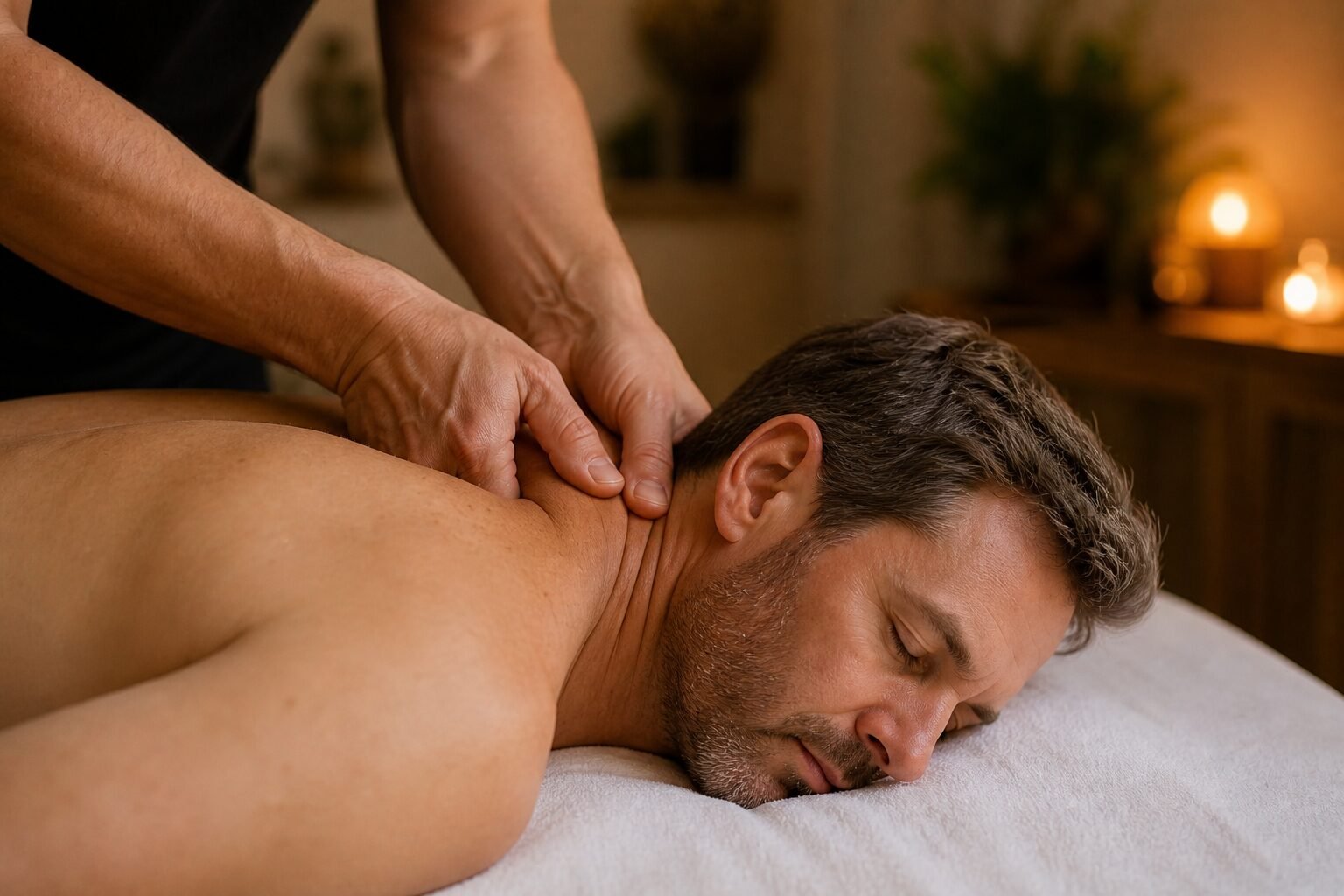
How Massage Shepparton Treats Neck and Shoulder Pain
Massage directly addresses the muscular and soft-tissue causes of neck and shoulder pain.
It doesn’t mask the symptom.
It works on what’s creating it.
What treatment typically involves:
✔ Trigger point therapy — sustained pressure on specific knots within the muscle. Releases the point. Reduces referred pain. Often creates immediate relief in the area.
✔ Deep tissue work — firm, focused pressure through the upper trapezius, levator scapulae, and neck extensors. Releases chronic holding patterns that have built up over months or years. Learn more about deep tissue massage here.
✔ Myofascial release — slow, sustained work through the connective tissue. Restores movement. Reduces the stiffness and restriction that limits neck rotation.
✔ Scalp and head work — tension in the neck is often connected to tension in the scalp and jaw. Indian head massage addresses the full upper chain — from shoulders through the neck, skull, and scalp.
✔ Shoulder girdle and upper back — the rhomboids, infraspinatus, and mid-trapezius all contribute to shoulder pain. Effective treatment covers the full region — not just the most obvious spot.
👉 The key difference between massage and stretching at home:
Stretching works on length.
Massage works on the neuromuscular system — the pattern of tension itself.
That’s why people who stretch regularly can still carry enormous tension in the neck and shoulders.
Real Scenarios: Who This Affects in Shepparton
Neck and shoulder pain is not just an office worker problem.
It affects people across very different lives.
The desk worker
Eight hours at a screen.
Head slightly forward.
Shoulders slightly raised.
By Thursday, turning the head to reverse the car is uncomfortable.
The tradesperson
Overhead work, repetitive tools, sustained awkward positions.
The dominant side carries significantly more load.
Over years, that asymmetry becomes structural.
The parent
Holding, carrying, feeding, and lifting — often on the same side.
The neck and shoulder complex absorbs all of it.
The driver
Long hauls, fixed grip, limited movement.
The neck extensors and upper traps stay contracted for hours.
👉 Whatever the cause — massage Shepparton addresses the result.
The accumulated tension. The trigger points. The restricted movement.
What to Expect From Your First Session
If you haven’t had targeted neck and shoulder treatment before, here’s what a typical session looks like.
Assessment first
Your therapist asks where the pain is.
How long you’ve had it.
What makes it worse.
Whether it refers into the head, arm, or between the shoulder blades.
This shapes the treatment.
Treatment
Work focuses on the neck, upper traps, shoulders, and upper back.
Often the scalp and jaw are included.
Pressure is firm but controlled.
You may feel strong sensation in trigger point areas.
That sensation — the ‘good hurt’ — typically fades within seconds as the point releases.
After the session
Most people notice improved neck rotation immediately.
The shoulders feel lower and less raised.
The head feels lighter.
Some mild soreness the next day is normal.
It clears within 24–48 hours.

Why Mobile Massage Shepparton Works Particularly Well for This
Getting to a clinic when your neck is stiff and uncomfortable is its own challenge.
Sitting in a car.
Parking.
Waiting.
👉 Mobile massage Shepparton removes all of that.
Your therapist comes to you.
You don’t travel.
You don’t sit in a waiting room.
You don’t drive home afterwards with a treated neck braced against the headrest.
You stay in your own space.
The session happens there.
And when it’s done — you rest there.
That rest window matters.
The tissue responds to treatment in the hours that follow.
Stillness supports that process.
Learn more about mobile massage in Shepparton here.
How Often Should You Book?
Frequency depends on the severity and history of your pain.
A practical guide:
- Weekly — acute pain, restricted movement, or tension that’s affecting sleep and daily function
- Fortnightly — maintenance once the acute phase has resolved
- Monthly — prevention and general upkeep
👉 For widespread tension across the neck, shoulders, upper back, and beyond — a two-hour massage allows thorough coverage without rushing any area.
Consistency matters more than any single session.
The tension built up over months.
It takes more than one appointment to fully unwind it.

What Helps Between Sessions
Massage addresses the existing tension.
These habits prevent it from coming straight back.
✔ Screen height — raise your monitor to eye level. Removes the forward head load immediately.
✔ Hourly movement breaks — stand, roll the shoulders, rotate the neck gently. Interrupts sustained static loading.
✔ Pillow height — your pillow should keep the neck neutral, not pushed forward or dropped to the side. This matters for 7–8 hours every night.
✔ Shoulder awareness — notice if you raise or brace your shoulders under stress. Consciously drop them. Repeat through the day.
✔ Heat — a wheat bag on the neck and upper traps for 15–20 minutes. Reduces guarding. Keeps tissue more responsive between sessions.
⚠️ Avoid prolonged phone use with the neck flexed forward.
Even 20 minutes of sustained forward flexion creates significant cervical load.
Common Myths About Neck and Shoulder Pain
❌ “It will go away on its own.”
Tension that has been building for months rarely resolves without intervention.
Rest helps temporarily.
But the pattern returns the moment normal activity resumes.
❌ “I just need to stretch more.”
Stretching improves length.
It doesn’t release trigger points.
It doesn’t reset the neuromuscular pattern.
That’s what massage does.
❌ “It’s not serious enough to treat.”
Untreated neck tension contributes to headaches, jaw pain, disrupted sleep, and referred arm symptoms.
Early treatment prevents compounding.
Ready to Get Relief?
Neck and shoulder pain doesn’t have to be something you manage around.
It’s treatable.
Often significantly — in just a few sessions.
If you’ve been searching for massage Shepparton to address tension that keeps coming back — targeted treatment is the right next step.
Professional. Precise. Delivered at home.
Explore all available services here. | Learn more about your therapist.