You make it through the hard week.
The deadline passes. The school holidays begin. The weekend finally arrives.
And then — almost as if on cue — the migraine hits.
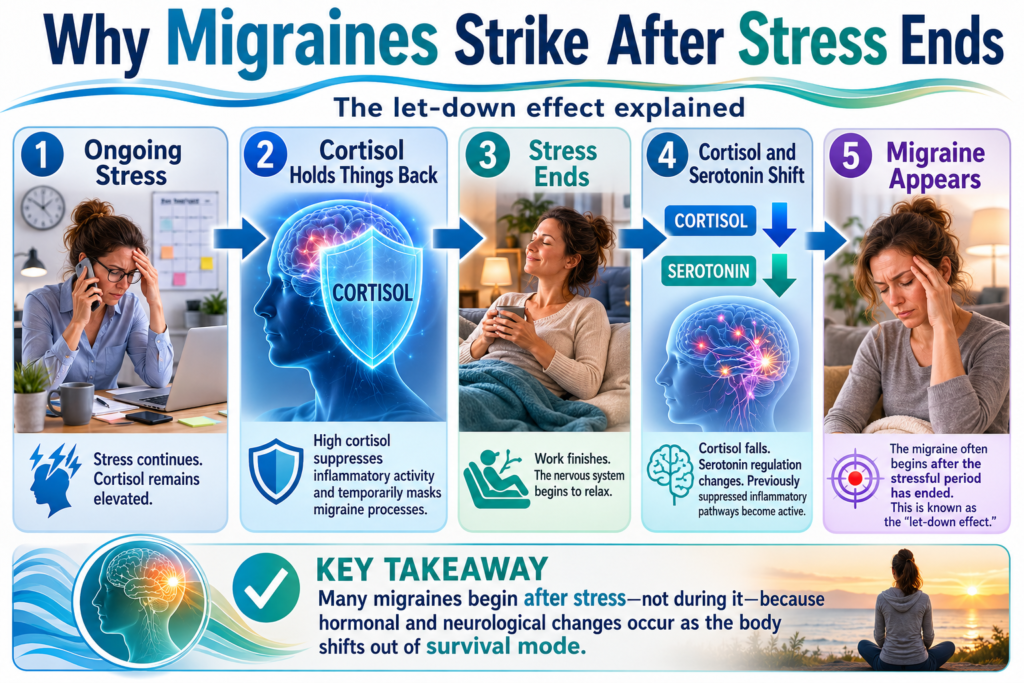
It doesn’t happen during the stress. It happens after.
This isn’t bad luck. It isn’t coincidence.
It’s a well-documented physiological phenomenon called the let-down migraine — and it affects far more people than realise it has a name.
Understanding why it happens is the first step to breaking the pattern. And for many people receiving remedial massage in Shepparton, targeted treatment has significantly reduced how often and how severely let-down migraines occur.

What Is the Let-Down Migraine?
A let-down migraine — sometimes called a stress migraine or weekend migraine — occurs in the hours or days after a period of sustained stress ends.
The migraine doesn’t arrive during the pressure.
It arrives when you finally exhale.
Research published in the journal Neurology identified this pattern clearly.
People with chronic migraines were significantly more likely to experience an attack in the 24 hours following a drop in stress — not during peak stress itself.
⚠️ This is why so many people get migraines on Friday evenings, Saturday mornings, or the first day of a holiday.
The body was holding it together under pressure.
The moment that pressure releases — the migraine arrives.
The Cortisol Connection
To understand why this happens, you need to understand cortisol.
Cortisol is your primary stress hormone.
When you’re under sustained pressure — work demands, family stress, difficult deadlines — cortisol rises.
It keeps you alert. It suppresses inflammation. It holds the body in a functional state of readiness.
👉 This is the part most people don’t realise.
Cortisol is actually suppressing migraine activity while it’s elevated.
It’s holding the pain response at bay.
The moment stress resolves and cortisol begins to drop — that suppression lifts.
The inflammatory and neurological processes that were being held back are suddenly free to fire.
The result: a migraine that arrives precisely when you thought you were safe.
The Serotonin Drop That Triggers the Attack
Cortisol isn’t the only hormone involved.
Serotonin plays a central role in migraine physiology.
Serotonin helps regulate pain, mood, and vascular tone in the brain.
During sustained stress, serotonin is depleted.
The body burns through it faster than it can replenish it.
When stress finally ends and the nervous system shifts toward relaxation, serotonin levels can drop sharply.
That drop causes blood vessels in the brain to dilate.
The dilation triggers the inflammatory cascade that produces migraine pain.
👉 This is why let-down migraines often feel different from typical stress headaches.
They’re deeper. More intense. Often accompanied by visual disturbance, nausea, or photosensitivity.
Because they’re driven by vascular and neurological changes — not just muscle tension.
Why the Neck and Shoulders Make It Worse
The hormonal mechanism is the trigger.
But the muscular environment determines how severe the attack becomes.
During a stressful period, the muscles of the neck and upper back accumulate tension.
The upper trapezius elevates and braces.
The suboccipital muscles at the base of the skull tighten progressively.
The levator scapulae shortens from sustained shoulder guarding.
These muscles carry trigger points — localised areas of chronic contraction that refer pain into the skull, temples, and behind the eyes.
⚠️ When cortisol drops and the migraine cascade begins, it fires into a system that’s already primed.
The vascular changes of the let-down migraine amplify through the muscular tension already sitting in the neck and upper back.
What might have been a mild headache becomes a full migraine episode — because the tissue was loaded and waiting.
How Massage Shepparton Targets the Let-Down Pattern
Effective treatment for let-down migraines works on two levels.
1. Reducing the accumulated muscular tension before cortisol drops.
The goal is to lower the baseline tension in the neck and upper back during the stress period — so the system isn’t pre-loaded when the let-down occurs.
Regular remedial massage throughout a high-pressure period does exactly this.
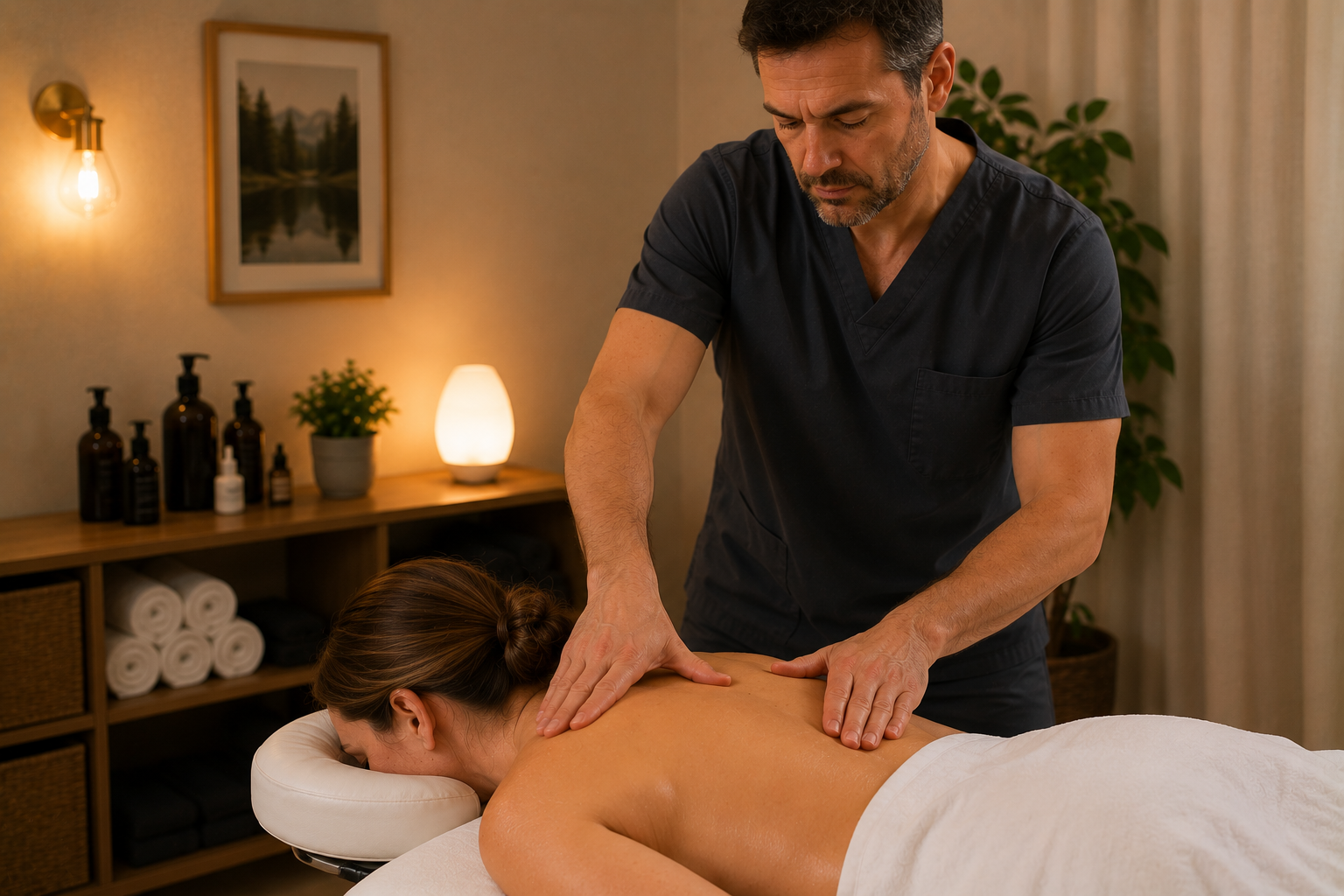
It reduces trigger point activity in the upper trapezius, suboccipital group, and levator scapulae.
It gives the tissue nowhere near as much tension to amplify through when cortisol falls.
2. Supporting the nervous system through the cortisol transition.
Migraine ease massage is specifically structured to work with the parasympathetic nervous system — encouraging a gradual, supported downregulation rather than a sharp hormonal drop.
Slow, rhythmic techniques calm the nervous system progressively.
This reduces the severity of the cortisol and serotonin shift — making the let-down itself less abrupt, and the migraine it produces less severe.
Techniques That Make the Difference
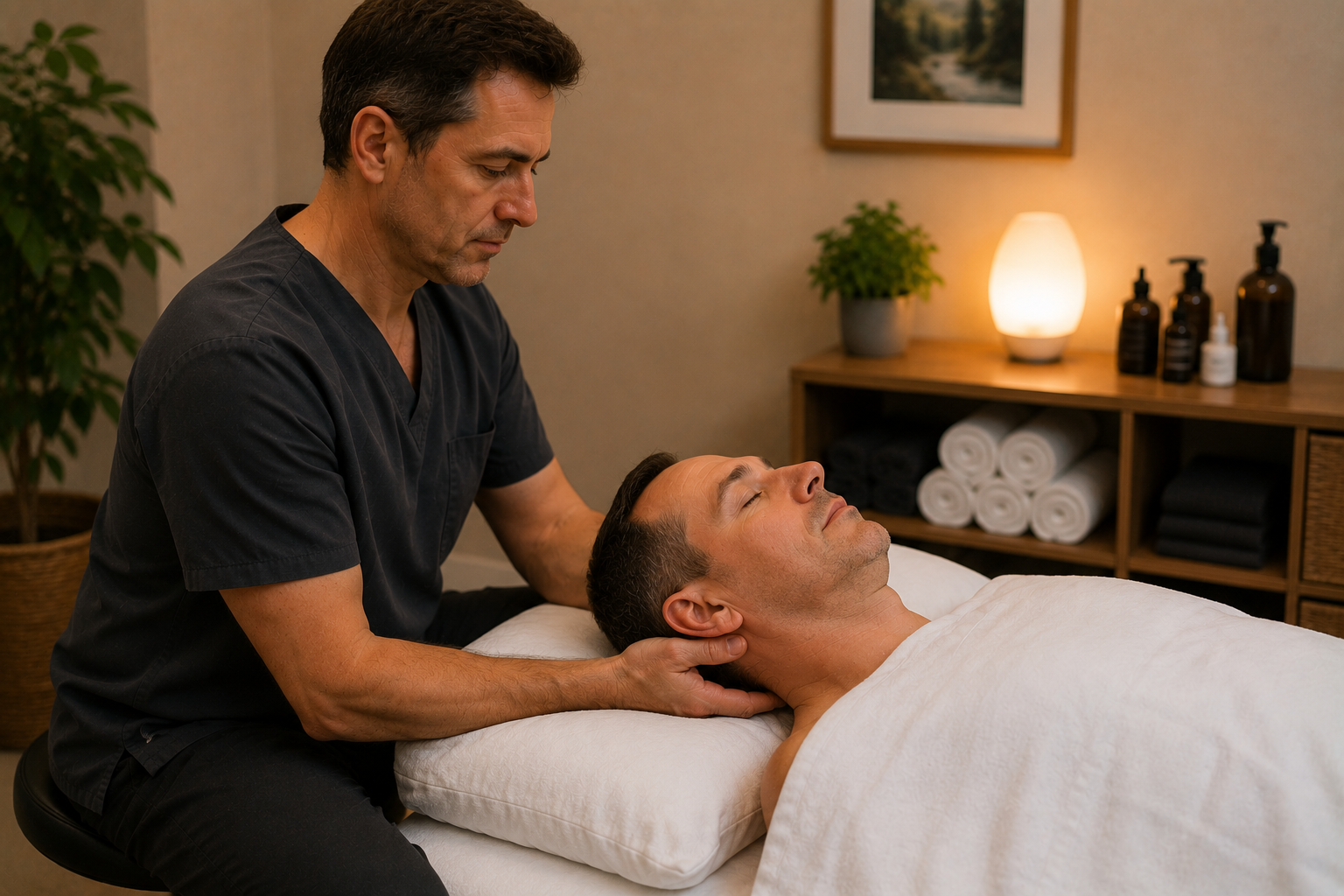
🔹 Suboccipital release — careful, sustained decompression of the four small muscles at the base of the skull. Reduces one of the most direct contributors to migraine onset and severity by relieving pressure on the greater occipital nerve.
🔹 Trigger point therapy to the upper trapezius and levator scapulae — these muscles accumulate trigger points rapidly during stress. Releasing them before the let-down period removes the muscular amplifier that makes cortisol-drop migraines worse.
🔹 Deep tissue massage to the posterior neck and upper back — addresses the deeper chronic tightness that builds over weeks of sustained stress. Particularly important for people who carry tension in their upper back without always noticing it consciously.
🔹 Parasympathetic activation techniques — slow effleurage, rhythmic strokes, and sustained pressure work together to shift the nervous system from sympathetic to parasympathetic mode. This is the equivalent of a guided, controlled cortisol descent — rather than the sharp drop that triggers the let-down migraine.
🔹 Indian head massage — a highly effective option for people whose let-down migraines involve significant scalp tension, temporal pressure, and mental fatigue. Works directly across the scalp, neck, and upper shoulder region during the vulnerable transition period.
A Real Scenario: A Shepparton Accountant and the Tax Season Migraine
Picture a self-employed accountant in his mid-forties based in Shepparton.
Every year, without fail, a migraine arrives on the Sunday after the end of the financial year.
He’s fine throughout the entire period — long hours, high pressure, constant deadlines.
But the moment the lodgements are submitted and the weekend begins, it hits.
He knows it’s coming. He’s experienced it for years.
He started fortnightly remedial massage sessions during the six weeks leading into the end-of-year period.
The sessions focused on progressive release of the upper trapezius, suboccipital muscles, and posterior neck — the tissue that was loading with every long work day.
In the first year of consistent treatment, the post-deadline migraine was significantly less severe than usual.
In the second year, it didn’t arrive at all.
That’s not a guarantee. Every nervous system is different.
But it illustrates what reducing the muscular baseline can do to the let-down pattern.
When to Book — Timing Matters
For let-down migraines, the timing of massage matters as much as the technique.
✔ Book during the stress period — not after.
The goal is to reduce accumulated tension before cortisol drops.
Booking a session on the Friday of a high-pressure week — or in the days before a holiday — is far more effective than waiting until the migraine has already arrived.
✔ Book consistently, not reactively.
One session helps. A series of sessions progressively lowers the baseline tension that amplifies let-down attacks.
✔ Mobile massage removes the barrier.
If driving to a clinic during a busy or stressful period feels impossible, mobile massage in Shepparton means the therapist comes to you.
No travel. No extra stress. The session happens in your own environment — which accelerates the nervous system shift.
Relaxellent provides mobile massage throughout Shepparton, Mooroopna, Tatura, Benalla, Wangaratta, and surrounding areas — so location is rarely a barrier to consistent care.
Supporting the Let-Down Between Sessions
✔ Wind down gradually after high-stress periods. A sharp transition from intense pressure to complete rest amplifies the hormonal drop. A gradual decompression — light activity, gentle movement, a walk — softens the cortisol descent.
✔ Prioritise sleep consistency. Disrupted sleep during stressful periods depletes serotonin further. Protecting sleep quality during high-pressure weeks reduces the depth of the let-down drop. Massage for sleep can help when stress is actively disrupting rest.
✔ Stay hydrated. Dehydration lowers the migraine threshold significantly. During busy periods, it’s easy to let water intake slip — which compounds the hormonal vulnerability.
✔ Don’t skip meals. Blood sugar drops interact with the cortisol and serotonin changes of the let-down phase. Regular meals during and after stressful periods reduce one of the compounding triggers.
✔ Notice the pattern. If you consistently get migraines after specific stressors — end of term, long work periods, family events — that’s not random. It’s your let-down pattern. Knowing it lets you treat proactively rather than reactively.

The Let-Down Migraine Has a Logic — And a Solution
It feels cruel.
You push through the hard part. You finally get to rest. And then the pain arrives.
But the let-down migraine isn’t random punishment.
It’s a predictable physiological response to a specific set of hormonal and muscular conditions.
That means it can be anticipated. Managed. Reduced.
Massage Shepparton treatments — particularly when timed around the stress cycle rather than after the migraine — give the body what it needs to navigate the cortisol transition without tipping into a full attack.
👉 Explore the full range of treatments at Relaxellent and find the right approach for the migraine pattern your body has been running on.