It starts with a dull ache on the outside of your elbow.
Maybe after a long day at the keyboard. Maybe after a weekend of gardening or sport.
You rest it. You ice it. You wait.
But the pain keeps coming back.
If that sounds familiar, you may be dealing with tennis elbow — and you may be treating the wrong part of your arm.
Massage Shepparton therapists see this pattern regularly. The elbow is where the pain lives. But the source of the problem usually starts much higher up.
What Tennis Elbow Actually Is
Tennis elbow — clinically known as lateral epicondylalgia — is a condition affecting the tendons that attach to the outer elbow.
Specifically, it involves the extensor tendons.
These are the tendons that connect the forearm muscles responsible for extending the wrist and fingers back toward the hand.
When these muscles are overloaded — through repetitive strain, sustained gripping, or overuse — the tendon attachment point at the lateral epicondyle becomes irritated and painful.
⚠️ Despite the name, most people with tennis elbow have never picked up a racquet.
It’s extremely common in:
✔ Office workers using a mouse for hours daily ✔ Tradies and construction workers with heavy grip demand ✔ Gardeners doing sustained pruning, digging, or raking ✔ Mechanics, plumbers, and painters ✔ Anyone performing repetitive wrist and forearm movements
Why the Elbow Isn’t the Only Problem
Here’s what most people don’t know about tennis elbow.
The pain at the outer elbow is a result — not the cause.
The actual driver of the condition often sits further up the kinetic chain.
When the forearm extensor muscles are overworked, they don’t tighten in isolation.
The tension travels.
It moves up into the posterior forearm. Into the muscles of the outer upper arm. Into the elbow itself — where the tendons are anchored.
👉 But it also moves in the other direction.
Trigger points in the forearm extensors frequently refer pain into the outer elbow — mimicking the sensation of tendon pain even when the tendon itself is only mildly involved.
Treating only the elbow misses the majority of the tissue that’s driving the problem.
The Muscle Groups That Actually Drive the Pain
A good remedial massage assessment for tennis elbow doesn’t start at the elbow.
It starts at the neck and shoulder.
🔹 Cervical nerve roots (C6–C7) — nerve irritation in the lower neck can refer symptoms into the outer forearm and elbow. If the neck is contributing, no amount of elbow treatment will resolve the pain permanently.
🔹 Posterior shoulder and triceps — sustained tension in the triceps and posterior deltoid creates downstream load on the extensor muscles below the elbow.
🔹 Forearm extensor group — the primary site of muscular overload. The extensor carpi radialis brevis is almost always involved in tennis elbow presentations. Trigger points here refer pain directly to the outer elbow.
🔹 Brachioradialis — a frequently overlooked muscle running along the outer forearm. When tight, it compresses the soft tissue around the lateral epicondyle and significantly amplifies pain at the attachment site.
This is why a whole-arm, whole-pattern approach is essential.
How Massage Shepparton Treats Tennis Elbow
Effective treatment addresses every layer of the problem — not just the painful point.
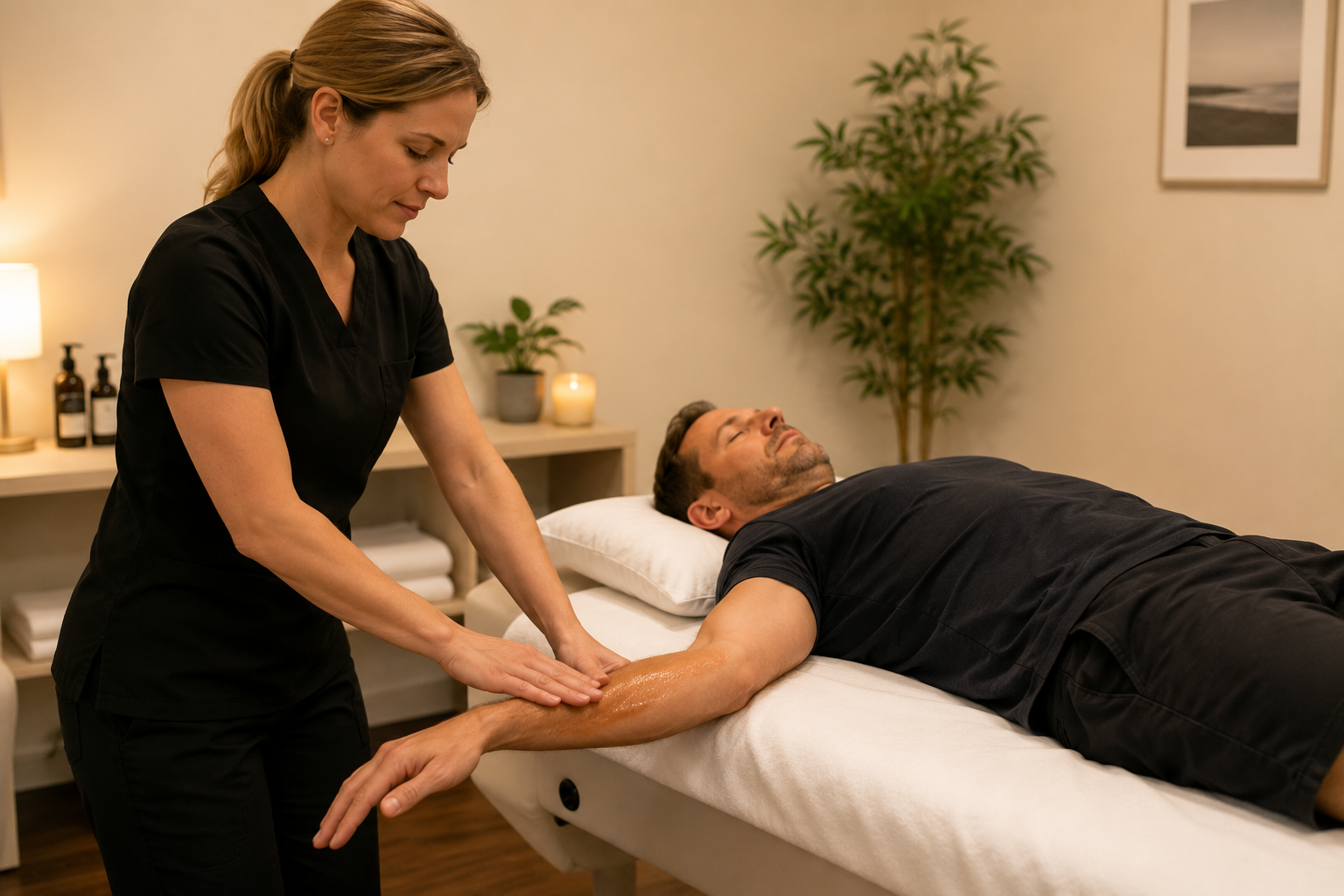
🔹 Trigger point therapy — sustained pressure is applied to the active trigger points in the forearm extensors and brachioradialis. When these release, the referred pain at the elbow often reduces significantly — sometimes within a single session.
🔹 Myofascial release — slow, sustained work along the fascial lines of the forearm and posterior upper arm. This reduces the chronic tensile load on the extensor tendons without applying direct pressure to the already-irritated attachment site.
🔹 Deep tissue massage — applied to the posterior forearm and upper arm to release the accumulated muscle tension driving the overload at the elbow. This is most effective in subacute and chronic presentations where the initial acute inflammation has settled.
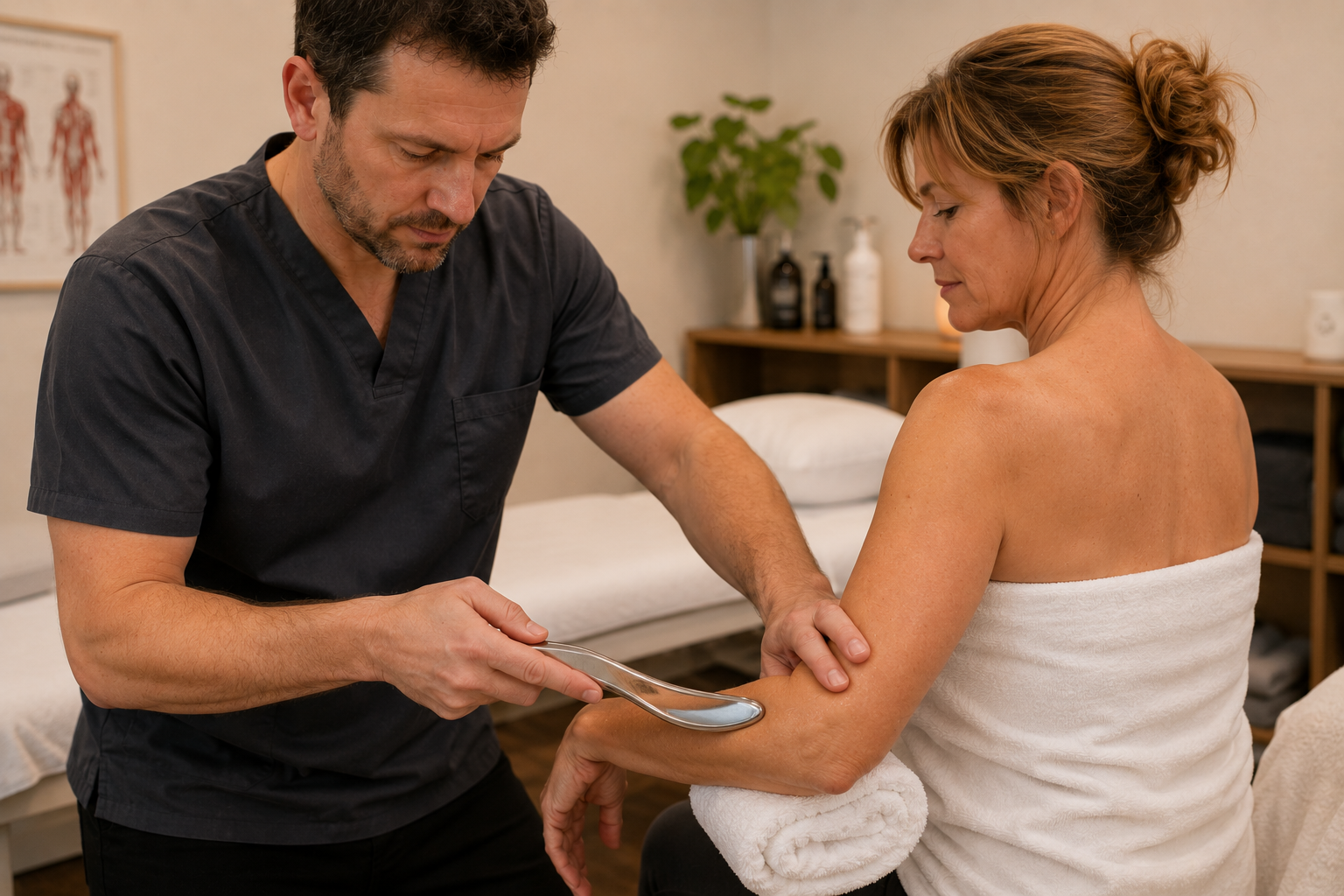
🔹 IASTM therapy — instrument-assisted soft tissue mobilisation is one of the most effective tools for tennis elbow. The stainless-steel instruments allow the therapist to detect and treat fascial adhesions and tendon dysfunction with a precision that hands alone can’t reach. IASTM directly stimulates collagen remodelling at the tendon — supporting actual structural repair, not just symptom relief.
⚠️ Direct aggressive pressure over the lateral epicondyle is avoided in acute presentations.
The goal is to reduce the load going into the tendon — not to compress an already irritated attachment site.
A Real Scenario: A Shepparton Tradie With Six Months of Elbow Pain
Picture a carpenter in his late thirties.
He first noticed the outer elbow ache after a particularly heavy week of framing work.
He assumed it would settle. It didn’t.
Six months later, he couldn’t grip his coffee mug in the morning without pain.
Shaking hands was uncomfortable. Lifting anything with his palm facing down was almost impossible.
He’d tried rest. He’d tried a compression strap. He’d taken anti-inflammatories.
Nothing held.
When he came in for treatment, the assessment found significant trigger point activity throughout the forearm extensors and brachioradialis — plus tightness in the posterior shoulder and lower neck that had gone entirely unaddressed.
After four sessions combining trigger point therapy, IASTM, and deep tissue work to the posterior arm, his grip strength had measurably improved.
Morning stiffness had reduced.
The referred ache that had been constant for months was now only present under heavy load.
That’s the difference a whole-arm approach makes.
What Makes Tennis Elbow Worse
Understanding what aggravates the condition helps protect the tissue between sessions.
❌ Continued repetitive gripping without modification — the tendon cannot repair if it’s constantly being reloaded. Workload management matters.
❌ Stretching the wrist extensors aggressively — counterintuitively, forced stretching of an already irritated tendon can increase load at the attachment site and slow healing.
❌ Ignoring the neck and shoulder — if cervical nerve irritation is contributing, local elbow treatment alone will produce temporary relief at best.
❌ Waiting too long — acute tennis elbow responds faster than chronic. The longer the tendon remains in a state of failed healing, the more established the dysfunction becomes.
Between Sessions: What Actually Helps
Massage creates the conditions for recovery.
What you do between sessions determines how quickly it sticks.
✔ Modify the aggravating activity — not necessarily stopping, but reducing volume, load, and duration.
✔ Isometric wrist extension exercises — research supports isometric loading as a way to stimulate tendon repair without overloading the attachment. Ask your therapist for guidance on load and reps.
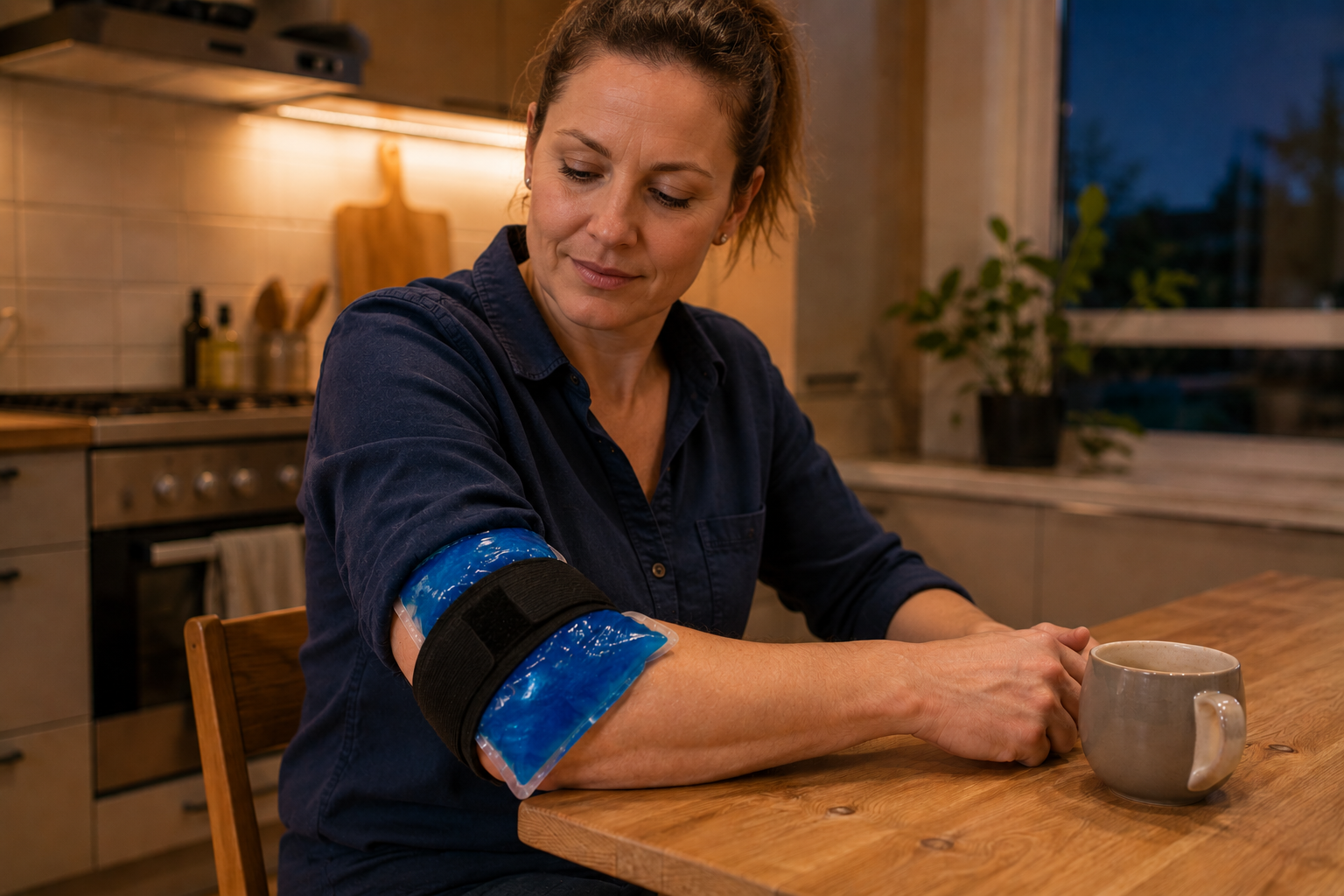
✔ Heat before activity — a warm pack over the forearm before demanding work increases tissue extensibility and reduces strain at the tendon.
✔ Ice after activity — if the elbow flares after use, brief icing reduces acute irritation at the attachment site.
✔ Ergonomic review — if mouse position, keyboard height, or tool grip is contributing, adjusting these removes the repetitive strain that’s reloading the tendon daily.
👉 If long work hours mean evenings are your only realistic treatment window, late-night mobile massage removes the barrier entirely.
A therapist comes to you — no driving with a painful grip, no recovery time lost in transit.
Tennis Elbow Doesn’t Have to Become a Chronic Problem
Left unaddressed, tennis elbow can persist for 12 to 18 months — sometimes longer.
The tendon enters a cycle of failed healing.
The surrounding muscles stay tight. The attachment site stays irritated. The pain keeps returning.
Massage Shepparton treatments interrupt that cycle.
They reduce the muscular load going into the tendon.
They address the trigger points, fascial restrictions, and compensatory patterns that keep the pain alive.
And when combined with IASTM, they support actual tendon repair — not just temporary relief.
👉 Explore the full range of treatments at Relaxellent Shepparton and find out which approach is right for where your elbow is right now.
It starts with a dull ache on the outside of your elbow.
Maybe after a long day at the keyboard. Maybe after a weekend of gardening or sport.
You rest it. You ice it. You wait.
But the pain keeps coming back.
If that sounds familiar, you may be dealing with tennis elbow — and you may be treating the wrong part of your arm.
Massage Shepparton therapists see this pattern regularly. The elbow is where the pain lives. But the source of the problem usually starts much higher up.

What Tennis Elbow Actually Is
Tennis elbow — clinically known as lateral epicondylalgia — is a condition affecting the tendons that attach to the outer elbow.
Specifically, it involves the extensor tendons.
These are the tendons that connect the forearm muscles responsible for extending the wrist and fingers back toward the hand.
When these muscles are overloaded — through repetitive strain, sustained gripping, or overuse — the tendon attachment point at the lateral epicondyle becomes irritated and painful.
⚠️ Despite the name, most people with tennis elbow have never picked up a racquet.
It’s extremely common in:
✔ Office workers using a mouse for hours daily ✔ Tradies and construction workers with heavy grip demand ✔ Gardeners doing sustained pruning, digging, or raking ✔ Mechanics, plumbers, and painters ✔ Anyone performing repetitive wrist and forearm movements
Why the Elbow Isn’t the Only Problem
Here’s what most people don’t know about tennis elbow.
The pain at the outer elbow is a result — not the cause.
The actual driver of the condition often sits further up the kinetic chain.
When the forearm extensor muscles are overworked, they don’t tighten in isolation.
The tension travels.
It moves up into the posterior forearm. Into the muscles of the outer upper arm. Into the elbow itself — where the tendons are anchored.
👉 But it also moves in the other direction.
Trigger points in the forearm extensors frequently refer pain into the outer elbow — mimicking the sensation of tendon pain even when the tendon itself is only mildly involved.
Treating only the elbow misses the majority of the tissue that’s driving the problem.
The Muscle Groups That Actually Drive the Pain
A good remedial massage assessment for tennis elbow doesn’t start at the elbow.
It starts at the neck and shoulder.
🔹 Cervical nerve roots (C6–C7) — nerve irritation in the lower neck can refer symptoms into the outer forearm and elbow. If the neck is contributing, no amount of elbow treatment will resolve the pain permanently.
🔹 Posterior shoulder and triceps — sustained tension in the triceps and posterior deltoid creates downstream load on the extensor muscles below the elbow.
🔹 Forearm extensor group — the primary site of muscular overload. The extensor carpi radialis brevis is almost always involved in tennis elbow presentations. Trigger points here refer pain directly to the outer elbow.
🔹 Brachioradialis — a frequently overlooked muscle running along the outer forearm. When tight, it compresses the soft tissue around the lateral epicondyle and significantly amplifies pain at the attachment site.
This is why a whole-arm, whole-pattern approach is essential.
How Massage Shepparton Treats Tennis Elbow
Effective treatment addresses every layer of the problem — not just the painful point.
🔹 Trigger point therapy — sustained pressure is applied to the active trigger points in the forearm extensors and brachioradialis. When these release, the referred pain at the elbow often reduces significantly — sometimes within a single session.
🔹 Myofascial release — slow, sustained work along the fascial lines of the forearm and posterior upper arm. This reduces the chronic tensile load on the extensor tendons without applying direct pressure to the already-irritated attachment site.
🔹 Deep tissue massage — applied to the posterior forearm and upper arm to release the accumulated muscle tension driving the overload at the elbow. This is most effective in subacute and chronic presentations where the initial acute inflammation has settled.
🔹 IASTM therapy — instrument-assisted soft tissue mobilisation is one of the most effective tools for tennis elbow. The stainless-steel instruments allow the therapist to detect and treat fascial adhesions and tendon dysfunction with a precision that hands alone can’t reach. IASTM directly stimulates collagen remodelling at the tendon — supporting actual structural repair, not just symptom relief.
⚠️ Direct aggressive pressure over the lateral epicondyle is avoided in acute presentations.
The goal is to reduce the load going into the tendon — not to compress an already irritated attachment site.
A Real Scenario: A Tradie With Six Months of Elbow Pain
Picture a carpenter in his late thirties.
He first noticed the outer elbow ache after a particularly heavy week of framing work.
He assumed it would settle. It didn’t.
Six months later, he couldn’t grip his coffee mug in the morning without pain.
Shaking hands was uncomfortable. Lifting anything with his palm facing down was almost impossible.
He’d tried rest. He’d tried a compression strap. He’d taken anti-inflammatories.
Nothing held.
When he came in for treatment, the assessment found significant trigger point activity throughout the forearm extensors and brachioradialis — plus tightness in the posterior shoulder and lower neck that had gone entirely unaddressed.
After four sessions combining trigger point therapy, IASTM, and deep tissue work to the posterior arm, his grip strength had measurably improved.
Morning stiffness had reduced.
The referred ache that had been constant for months was now only present under heavy load.
That’s the difference a whole-arm approach makes.

What Makes Tennis Elbow Worse
Understanding what aggravates the condition helps protect the tissue between sessions.
❌ Continued repetitive gripping without modification — the tendon cannot repair if it’s constantly being reloaded. Workload management matters.
❌ Stretching the wrist extensors aggressively — counterintuitively, forced stretching of an already irritated tendon can increase load at the attachment site and slow healing.
❌ Ignoring the neck and shoulder — if cervical nerve irritation is contributing, local elbow treatment alone will produce temporary relief at best.
❌ Waiting too long — acute tennis elbow responds faster than chronic. The longer the tendon remains in a state of failed healing, the more established the dysfunction becomes.
Between Sessions: What Actually Helps
Massage creates the conditions for recovery.
What you do between sessions determines how quickly it sticks.
✔ Modify the aggravating activity — not necessarily stopping, but reducing volume, load, and duration.
✔ Isometric wrist extension exercises — research supports isometric loading as a way to stimulate tendon repair without overloading the attachment. Ask your therapist for guidance on load and reps.
✔ Heat before activity — a warm pack over the forearm before demanding work increases tissue extensibility and reduces strain at the tendon.
✔ Ice after activity — if the elbow flares after use, brief icing reduces acute irritation at the attachment site.
✔ Ergonomic review — if mouse position, keyboard height, or tool grip is contributing, adjusting these removes the repetitive strain that’s reloading the tendon daily.
👉 If long work hours mean evenings are your only realistic treatment window, late-night mobile massage removes the barrier entirely.
A therapist comes to you — no driving with a painful grip, no recovery time lost in transit.
Tennis Elbow Doesn’t Have to Become a Chronic Problem
Left unaddressed, tennis elbow can persist for 12 to 18 months — sometimes longer.
The tendon enters a cycle of failed healing.
The surrounding muscles stay tight. The attachment site stays irritated. The pain keeps returning.
Massage Shepparton treatments interrupt that cycle.
They reduce the muscular load going into the tendon.
They address the trigger points, fascial restrictions, and compensatory patterns that keep the pain alive.
And when combined with IASTM, they support actual tendon repair — not just temporary relief.
👉 Explore the full range of treatments at Relaxellent Shepparton and find out which approach is right for where your elbow is right now.