The first step out of bed is the worst.
A sharp, stabbing pain in the heel.
You limp to the bathroom. After a few minutes it eases — but it never fully goes away.
By the end of a long day on your feet, it’s back. Deeper. More persistent.
If this pattern sounds familiar, you’re likely dealing with plantar fasciitis — one of the most common and most mismanaged foot conditions seen by remedial massage therapists.
The standard advice is to rest it, stretch it, and wear supportive shoes.
That advice isn’t wrong. But it’s incomplete.
Because for most people, the real driver of plantar fasciitis isn’t in the foot at all.
It starts higher up — in the calf, the Achilles tendon, and the fascial lines running all the way up the back of the leg.
Remedial massage in Shepparton is helping people finally address the full picture — and break a cycle that rest and orthotics alone rarely resolve.

What Plantar Fasciitis Actually Is
The plantar fascia is a thick band of connective tissue running along the sole of the foot.
It connects the heel bone to the base of the toes.
Its job is to absorb shock, support the arch, and help propel the foot during walking and running.
When it’s overloaded — through sustained standing, increased activity, poor footwear, or tight calf muscles — the fascia becomes irritated at its attachment point on the heel.
That irritation is plantar fasciitis.
The classic presentation:
✔ Sharp heel pain with the first steps of the morning ✔ Pain that eases after walking for a few minutes, then returns with prolonged activity ✔ Tenderness directly on the underside of the heel ✔ Arch tightness after sitting or resting for extended periods ✔ Pain that worsens after — not during — exercise
⚠️ The morning pain pattern is particularly telling.
During sleep, the plantar fascia shortens in a relaxed position.
The first steps of the day stretch an already-irritated structure — which is why that initial pain is often the sharpest of the day.
Why the Calf Is Almost Always Involved
Here’s the part most people aren’t told.
The plantar fascia doesn’t exist in isolation.
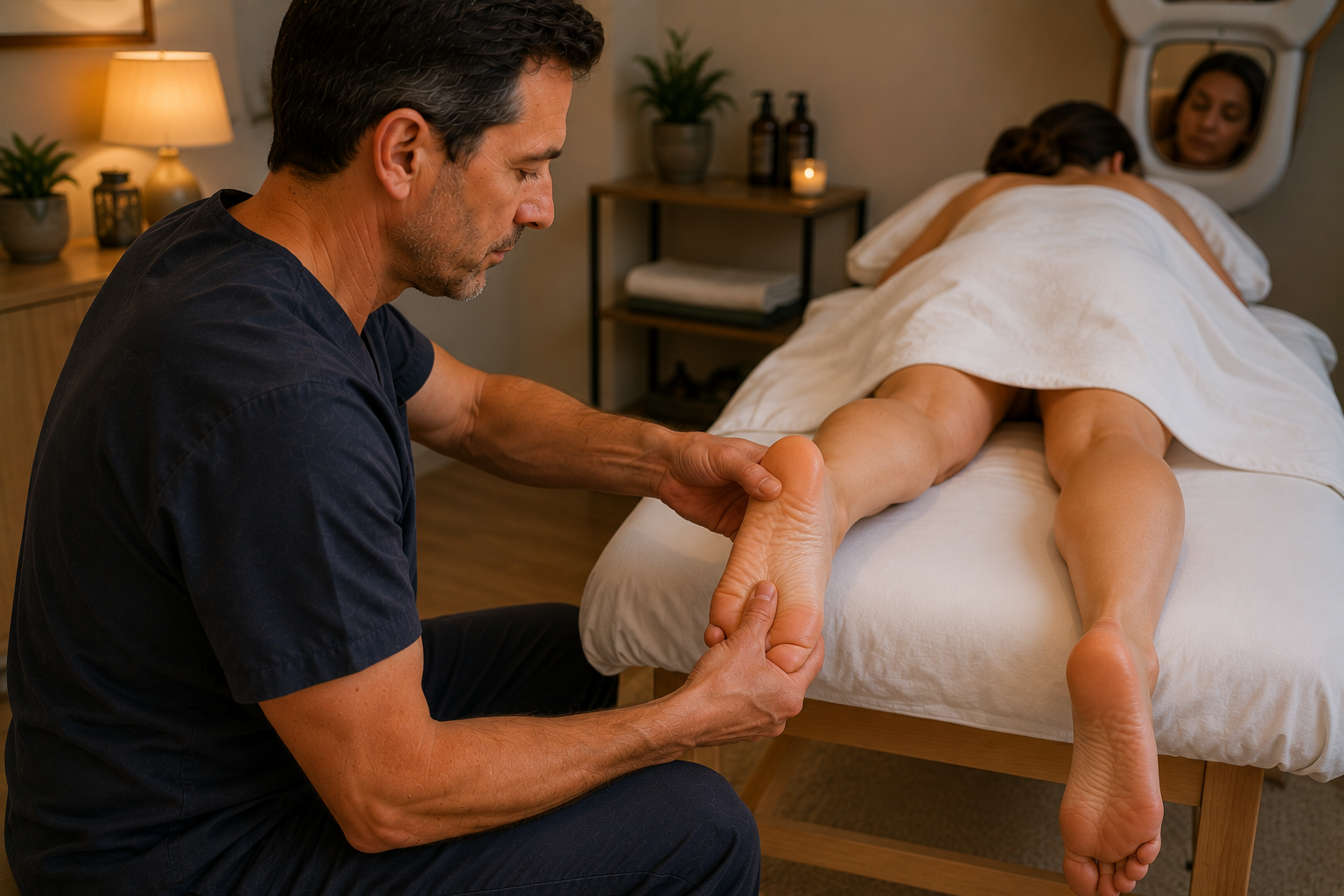
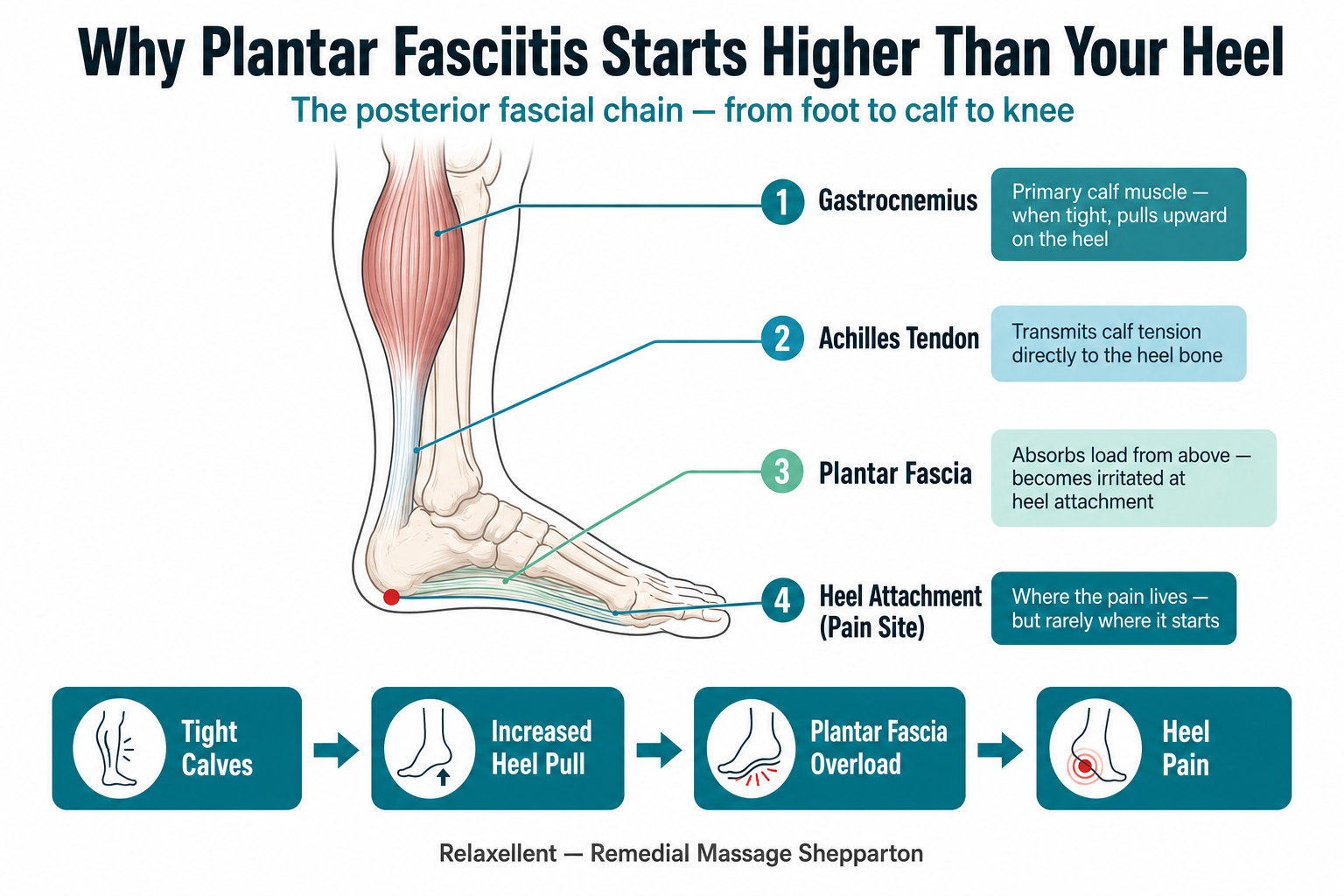
It’s part of a continuous fascial line — the superficial back line — that runs from the sole of the foot, up through the Achilles tendon, into the calf, behind the knee, up the hamstrings, and all the way to the base of the skull.
When any part of that line is tight, tension is transmitted along it.
👉 Tight calves are one of the most consistent contributors to plantar fasciitis.
The gastrocnemius and soleus — the two primary calf muscles — both attach to the heel via the Achilles tendon.
When they’re chronically shortened, they pull on the heel from above.
That constant upward tension loads the plantar fascia from its attachment point — exactly where the pain lives.
No amount of foot massage resolves plantar fasciitis if the calf tension driving it isn’t addressed.
The Other Structures That Contribute
A thorough assessment of plantar fasciitis looks well beyond the foot.
🔹 Gastrocnemius and soleus trigger points — both muscles develop trigger points under sustained load. The gastrocnemius in particular refers pain into the arch and heel — closely mimicking plantar fascia pain even when the fascia itself has limited involvement.
🔹 Tibialis posterior — a deep calf muscle that runs beneath the foot and supports the arch from the inside. When tight or dysfunctional, it increases load through the plantar fascia with every step.
🔹 Achilles tendon and paratenon — the soft tissue surrounding the Achilles is frequently restricted in plantar fasciitis presentations. Reduced mobility here increases the mechanical pull on the heel bone.
🔹 Intrinsic foot muscles — the small muscles within the foot itself — particularly the flexor digitorum brevis — are often inhibited and tight simultaneously, reducing the foot’s ability to absorb force independently of the fascia.
🔹 Hip and glute function — when the glutes are weak or inhibited, the lower leg compensates. More load is transferred through the foot with every stride. Addressing hip function is part of a complete plantar fasciitis treatment plan.
How Massage Addresses Plantar Fasciitis
Effective treatment works across the full kinetic chain — not just the painful point.
🔹 Deep tissue massage to the calf complex — sustained, specific work through the gastrocnemius and soleus releases the chronic shortening that pulls on the heel from above. This is often where the most immediate relief is felt — because it removes the primary mechanical driver. Deep tissue massage is the foundation of most plantar fasciitis treatment plans.
🔹 Trigger point therapy — active trigger points in the gastrocnemius, soleus, and tibialis posterior refer pain into the heel and arch. Releasing these removes a significant source of referred pain that compounds the local fascia irritation.
🔹 Myofascial release along the posterior chain — slow, sustained work along the fascial line from the calf to the plantar fascia reduces the tensile load travelling through the structure. This is particularly effective for chronic presentations where the fascia has become thickened and restricted.
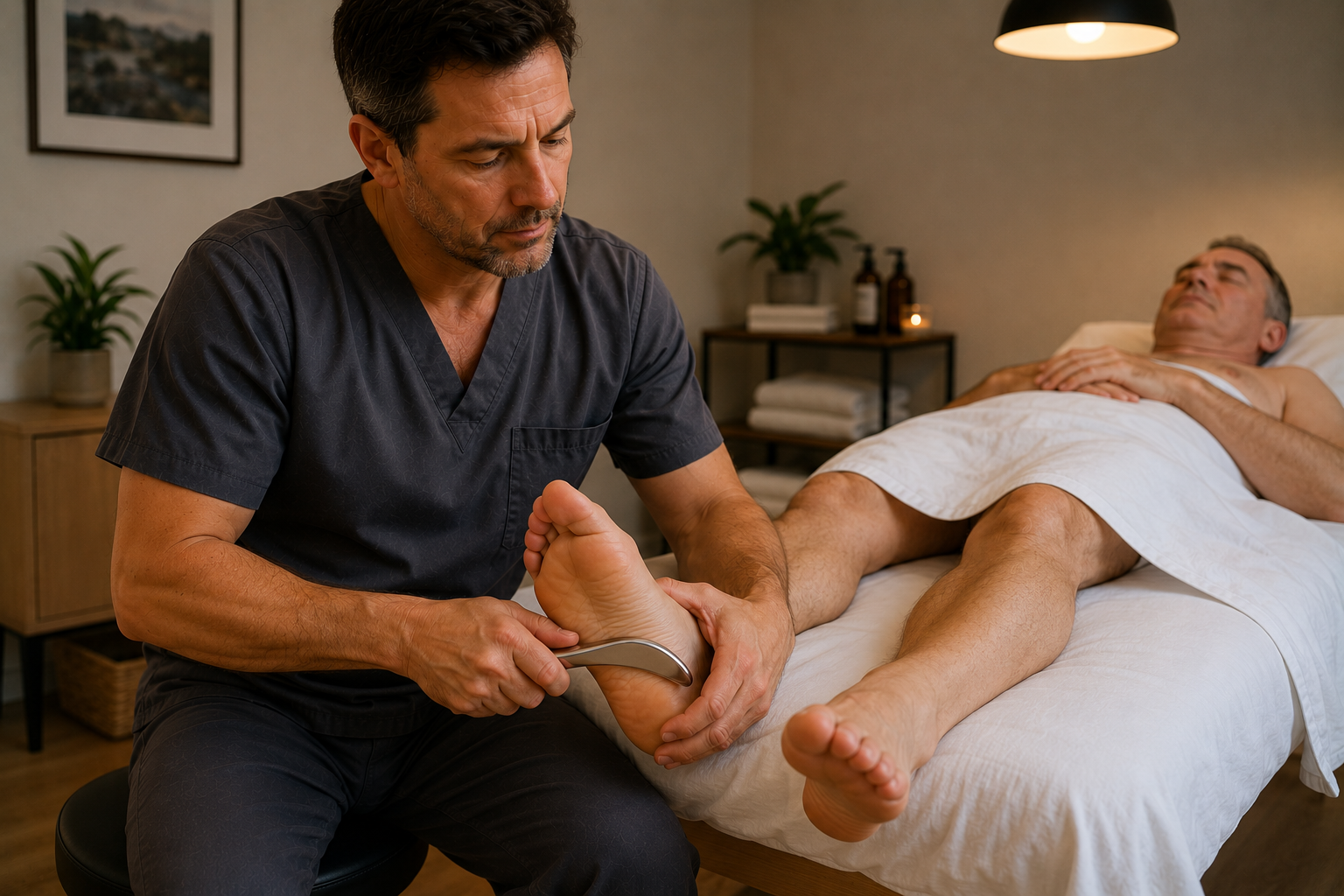
🔹 IASTM therapy — instrument-assisted soft tissue mobilisation applied along the plantar fascia and Achilles paratenon stimulates collagen remodelling and breaks down fascial adhesions with precision that manual work alone cannot achieve. Highly effective in subacute and chronic plantar fasciitis where tissue quality has deteriorated.
🔹 Intrinsic foot muscle work — specific work through the sole of the foot releases the small muscles that have been chronically bracing. This improves the foot’s independent shock-absorbing capacity and reduces reliance on the plantar fascia.
A Real Scenario: A Shepparton Teacher on Her Feet All Day
Picture a primary school teacher in her mid-forties.
She’s on her feet for six hours a day on hard classroom floors.
The heel pain started gradually — first only in the mornings, then through the afternoon, then after any extended walking.
She bought new shoes. She tried a heel insert. She stretched her calves every morning.
The pain eased slightly. But it never resolved.
When she came in for treatment, assessment found significant trigger point activity in both the gastrocnemius and tibialis posterior — muscles she’d never considered in relation to her foot pain.
Her calf flexibility was markedly reduced on the affected side.
After four sessions combining deep tissue work to the calf complex, trigger point release, and IASTM along the plantar fascia, she was walking to school without morning pain for the first time in eight months.
That’s what a whole-chain approach produces — compared with treating only the foot.
What Makes Plantar Fasciitis Worse
Understanding aggravating factors helps protect the tissue between sessions.
❌ Going barefoot on hard floors first thing in the morning — the fascia is at its shortest after sleep. Hard surfaces with no shock absorption spike the load at the attachment site immediately.
❌ Sustained standing without movement — static load through the foot without the pumping action of walking reduces circulation to the fascia and compresses the heel attachment.
❌ Aggressive calf stretching when acutely inflamed — paradoxically, forced stretching of a highly irritated fascia can increase strain at the heel attachment. Gentle, progressive stretching is appropriate; aggressive stretching is not.
❌ Ignoring the calf and treating only the foot — as outlined above, the calf is the primary mechanical driver in most presentations. Local foot treatment without calf release produces temporary relief at best.
Between Sessions: What Supports Recovery
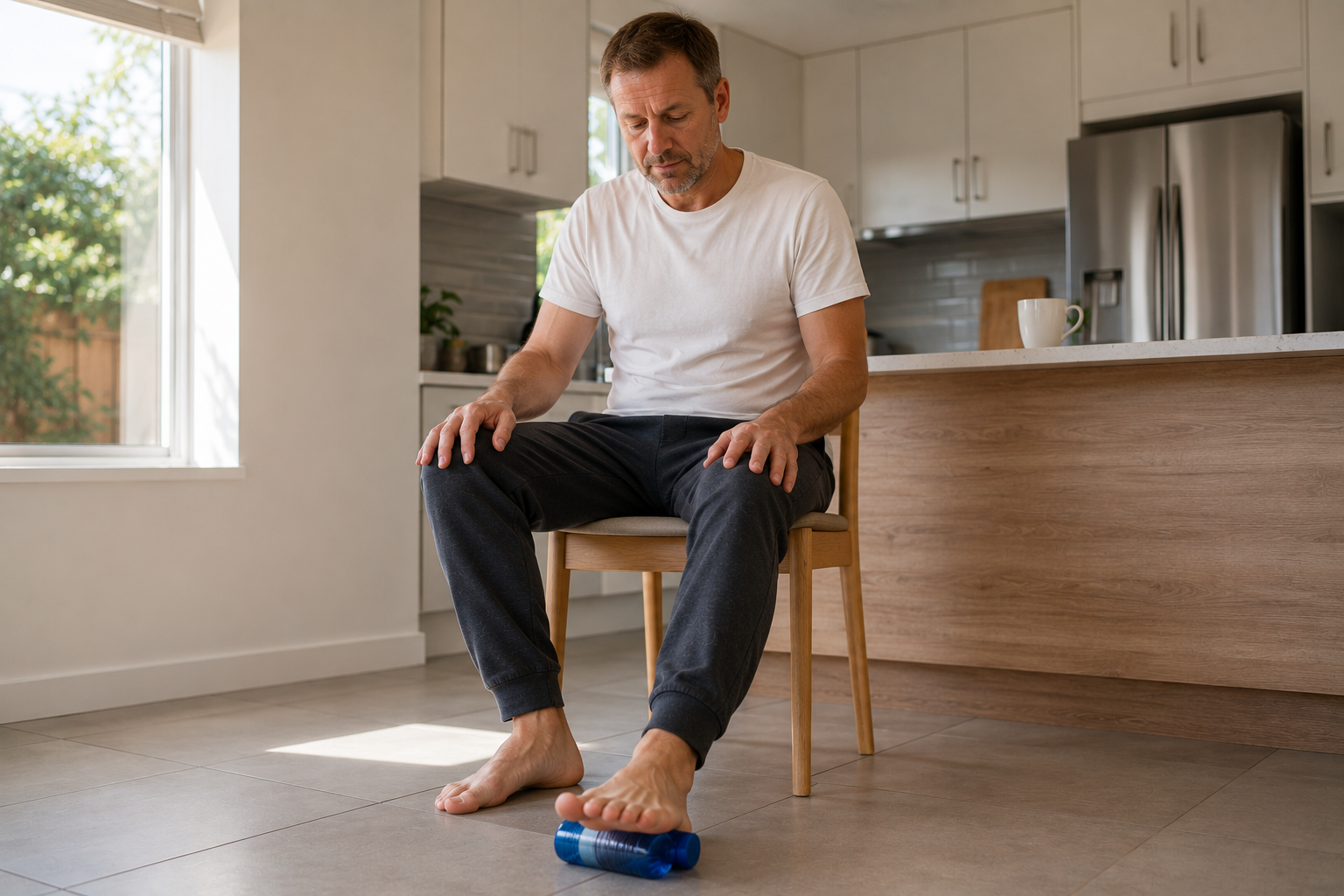
✔ Frozen water bottle rolling — roll the arch of the foot over a frozen water bottle for five minutes morning and evening. Combines gentle fascial mobilisation with localised anti-inflammatory effect.
✔ Towel scrunching — picking up a small towel with the toes strengthens the intrinsic foot muscles that support the arch independently of the plantar fascia.
✔ Calf stretching — gently — a sustained, low-load calf stretch held for 45–60 seconds (rather than a short aggressive stretch) progressively lengthens the gastrocnemius without spiking load at the heel.
✔ Footwear review — flat, unsupportive shoes on hard surfaces are a consistent aggravating factor. Even temporary use of supportive footwear during recovery reduces the daily load going into the fascia.
✔ Mobile massage between sessions — for people whose work or lifestyle means their feet are under sustained load daily, a mobile therapist coming to the home removes the barrier of clinic access and keeps the treatment consistent.
Relaxellent provides mobile remedial massage throughout Shepparton, Mooroopna, Kialla, Tatura, Benalla, and surrounding areas — so maintaining regular treatment is realistic regardless of schedule.
Plantar Fasciitis Responds Well — When You Treat the Right Thing
Left unaddressed, plantar fasciitis can become a chronic condition that limits activity, disrupts sleep, and affects gait patterns that create secondary problems in the knee, hip, and lower back.
But it responds well to targeted treatment.
The key is treating the entire chain — not just the painful point.
Calf release. Trigger point work. Fascial mobilisation. IASTM where indicated.
And consistency — because the tissue took time to reach this state, and it takes time to change.
👉 Explore the full range of treatments at Relaxellent and find the right approach for the heel pain that’s been slowing you down.