If you’re searching for massage Shepparton, you’re looking for real relief.
Not temporary. Not surface-level.
Something that actually fixes what’s been building.
Lower back pain is one of the most disruptive things a person can carry.
It affects how you sit.
It affects how you sleep.
It affects how you move through your day.
And if it’s been around long enough — it affects how you feel mentally too.
What starts as tightness after a long day at the desk can quietly become something that follows you everywhere.
The frustrating part isn’t usually the pain itself.
It’s not knowing what’s causing it.
It’s not understanding why nothing seems to fix it for long.
This guide changes that.
It explains what’s driving your lower back pain — and what targeted massage treatment can realistically do about it.

Why Lower Back Pain Is So Common in Shepparton
Lower back pain doesn’t usually appear out of nowhere.
In most cases, it builds slowly.
The causes are often surprisingly ordinary.
The most common contributors:
- Prolonged sitting — shortens the hip flexors and loads the lumbar spine. Gradually switches off the muscles that support it.
- Physical labour — repetitive bending and lifting creates chronic overload. One-sided movement patterns make it worse.
- Poor posture under load — leaning forward at a desk, looking down at a phone, driving without support. All place uneven stress on the lower spine.
- Stress and tension — the body’s stress response causes muscular bracing. It often shows up first in the lower back, hips, and jaw.
- Previous injury — old sprains or strains that weren’t fully rehabilitated. They create compensatory patterns that appear elsewhere in the body.
Shepparton has a wide mix of workers.
Desk-based professionals. Physical labourers. People in agriculture and trades.
Lower back pain affects all of them — in very different daily lives, in very similar ways.
What’s Actually Happening in Your Lower Back
Understanding the mechanism matters.
It changes what treatment actually makes sense.
Most lower back pain isn’t caused by a disc prolapse.
That’s less common than most people assume.
It’s usually driven by one or more of the following:
1. Muscle tension and guarding
The muscles around the lumbar spine contract to protect the area.
This happens in response to stress, strain, or injury.
Once established, the pattern becomes self-reinforcing.
The body holds the tension — even after the original trigger is gone.
2. Trigger points
These are hyper-irritable spots within muscle fibres.
They refer pain to nearby areas.
A trigger point in the glute, for example, can create strong pain felt in the lower back.
This makes it easy to treat the wrong area entirely.
3. Fascial restriction
Connective tissue surrounds and links muscles throughout the body.
Over time, it can become stiff and restrictive.
This limits movement.
It amplifies discomfort.
It often creates a pulling or dragging sensation — rather than sharp pain.
4. Hip and pelvis imbalance
Tight hip flexors or an uneven pelvis change how load moves through the spine.
This creates asymmetrical strain.
The back bears the consequence of an imbalance that started in the hips.
The key point:
Lower back pain is rarely just about the back.
The hips, glutes, and thoracic spine above are almost always involved.
How Massage Shepparton Addresses Lower Back Pain
Massage is particularly effective for muscular and soft-tissue pain.
It works on multiple layers at once.
It doesn’t just target one symptom in isolation.
Depending on what’s driving your pain, treatment may include:
✔ Deep tissue work — sustained pressure through the lumbar muscles to release deep, chronic tension. Learn more about deep tissue massage here.
✔ Trigger point therapy — direct pressure on specific points within the muscle. Deactivates the trigger. Reduces referred pain throughout the region.
✔ Glute and hip flexor release — targets the muscles above and below the lumbar spine. Often the most overlooked part of lower back treatment.
✔ Myofascial release — gentle, sustained work through the connective tissue. Restores mobility. Reduces the pulling sensation restricted fascia creates.
✔ IASTM — instrument-assisted soft tissue mobilisation. Uses specialised tools to work through dense adhesions and scar tissue. Explore IASTM treatment here.
Treatment isn’t one-size-fits-all.
A good remedial session starts with an assessment.
It identifies where the restriction originates — not just where it’s felt.
What to Expect From a Session
If you haven’t had targeted remedial work before, here’s what a typical session looks like.
1. Intake and Assessment
Your therapist asks about your symptoms.
Your history. Your daily patterns.
This is where the root cause gets identified — not just the complaint.
Questions might include how long you’ve had the pain.
What makes it better or worse.
Your work setup.
Any previous injuries.
2. Targeted Treatment
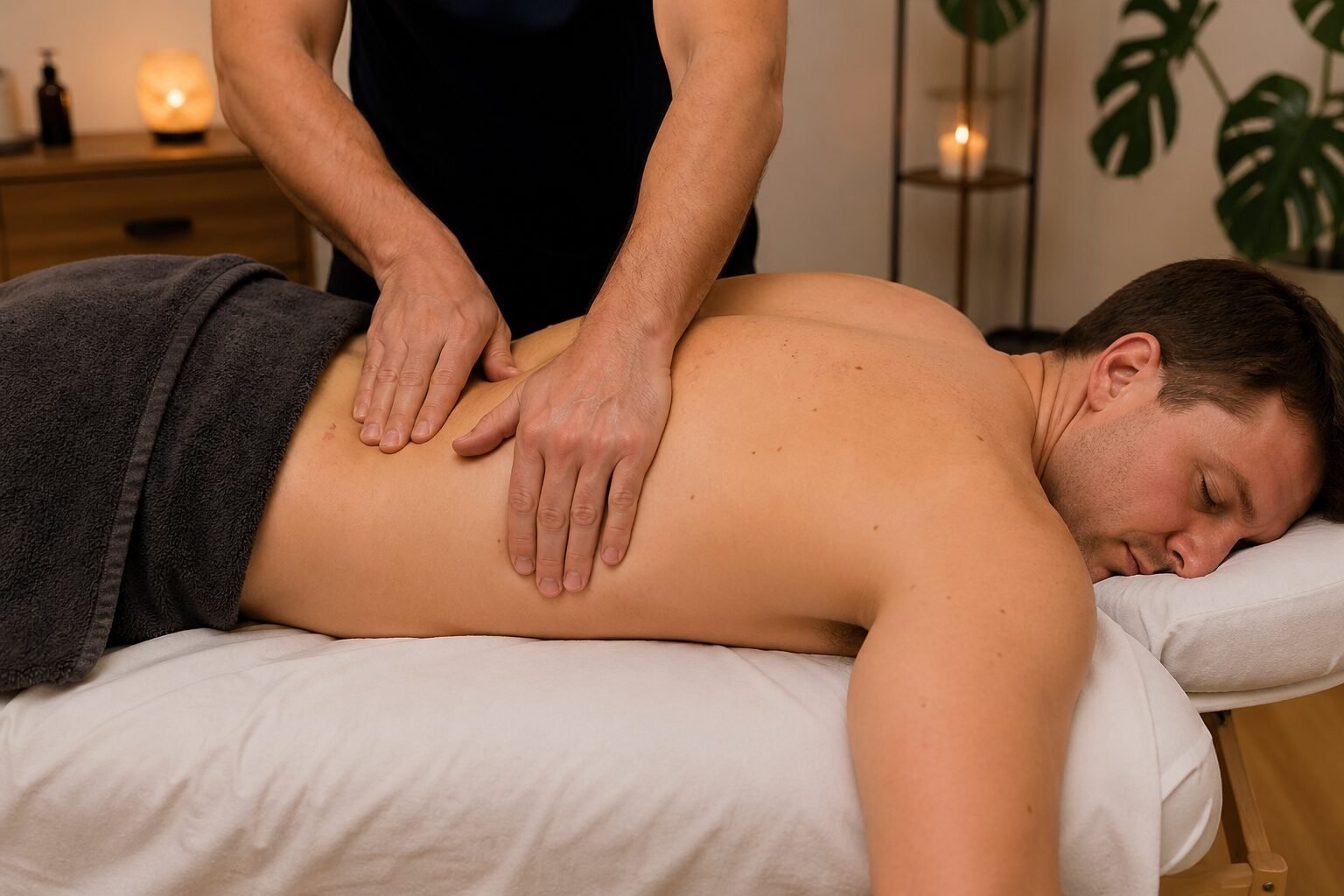
Work focuses on the lumbar region, glutes, and hips.
Often the thoracic spine and legs too.
Pressure may be firm in areas of deep tension.
But it should never feel damaging.
‘Good hurt’ is normal.
Sharp or intense pain is not.
Your therapist will always adjust.
3. Ongoing Adjustment
Pressure and technique adapt throughout the session.
Your feedback guides it.
The way the tissue responds guides it.
You’re always in control.
If something feels too much — say so.
If you need more pressure — say so.
A good therapist adjusts without hesitation.
4. Post-Treatment Guidance
Your therapist may suggest stretches or movement habits.
Small positioning adjustments to support the work between sessions.
These are usually simple.
Practical. A few minutes a day.
Many people notice reduced pain and improved mobility after the first session.
Others find relief builds progressively over three to four treatments.
This is especially true with chronic or long-standing pain.
Why Mobile Massage Makes a Real Difference for Lower Back Pain
For someone in pain, getting to a clinic is uncomfortable.
Driving with a sore back.
Sitting in a waiting room.
Then driving home again.
Each of those steps loads the exact area that needs rest.
Mobile massage removes all of that.
Your therapist comes to you.
Fully equipped.
Treatment happens in your own space.
Afterwards, you stay exactly where you are.
No commute. No car. No undoing the work.
This matters specifically for lower back pain.
The body responds to massage over the hours that follow a session.
That process is better supported by stillness.
Not by sitting in a car on the way home.
Learn more about mobile massage in Shepparton here.

How Often Should You Book?
The right frequency depends on your situation.
How long you’ve had the pain.
How your body responds.
As a general guide:
- Acute or recent onset — weekly sessions for the first three to four weeks. Interrupt the pattern before it becomes entrenched.
- Ongoing or chronic pain — weekly or fortnightly. Gradually unwind long-established tension. Build a new, lower baseline.
- Maintenance — monthly sessions once the acute phase has resolved. Prevent re-accumulation. Keep the body functioning well.
For more complex or widespread tension, a two-hour massage allows thorough work through the back, hips, glutes, and legs.
All in one appointment.
Without rushing through any area.
What to Do Between Sessions
Massage does the heavy lifting.
But what you do between appointments matters too.
It affects how quickly results hold.
It affects how long they last.
Practical habits that support lower back recovery:
✔ Daily gentle movement — short walks, light stretching. Avoid long static holds in any one position. Even 10 minutes of walking breaks the guarding cycle.
✔ Hip flexor stretching — a simple kneeling lunge, held for 30–60 seconds each side. Done daily. Makes a noticeable difference to lumbar load over time.
✔ Desk posture adjustments — hips above knees. Screen at eye level. Lower back supported. Small changes compound over an 8-hour day.
✔ Sleep position awareness — a pillow between the knees when side-sleeping. Reduces lumbar rotation. Takes pressure off the lower back overnight.
✔ Heat between sessions — a wheat bag or heat pack on the lower back for 15–20 minutes. Reduces guarding. Improves tissue readiness before your next treatment.
None of these require equipment.
None of them take more than a few minutes.
Small adjustments. Consistent use. Significant results over weeks.

When Massage Is the Right Tool — and When to Get Other Help
Massage is highly effective for muscular lower back pain.
That’s the majority of cases.
But it’s worth knowing when other input is needed.
Massage works well for:
✔ Muscle tension and protective guarding ✔ Trigger point pain and referred discomfort into the glutes or legs ✔ Postural strain from prolonged sitting or physical work ✔ Fatigue-related tightness and stress-driven muscular bracing
See a GP or specialist if:
✘ Pain is severe, constant, or rapidly worsening without explanation ✘ You have numbness, tingling, or weakness travelling into the legs or feet ✘ Pain follows a recent fall, accident, or direct impact ✘ There is any bowel or bladder involvement — this needs prompt medical assessment
For most people reading this, none of those apply.
Massage Shepparton is exactly the right place to start.
Ready to Address Your Lower Back Pain?
Lower back pain doesn’t have to be something you just put up with.
In most cases, it’s treatable.
Often faster than people expect.
Once the right approach is applied to the right cause.
If you’ve been searching for massage Shepparton to find relief that actually lasts — targeted remedial treatment is where to start.
You don’t need to wait until it gets worse.
You don’t need to keep managing around the edges.
Professional. Targeted. Delivered where you are.
Explore all available services. | Learn more about your therapist.