Your arm won’t lift past a certain point.
Getting dressed is painful. Reaching behind your back is nearly impossible.
And the stiffness seems to be getting worse —not better.
If that sounds familiar, you may be dealing with frozen shoulder.
It’s one of the most frustrating conditions people bring to massage Shepparton therapists — partly because it’s so misunderstood, and partly because the wrong approach can genuinely set things back.
This guide explains what frozen shoulder actually is, how massage fits into recovery, and what to realistically expect from treatment.

What Frozen Shoulder Actually Is
Frozen shoulder — clinically known as adhesive capsulitis — is a condition where the connective tissue surrounding the shoulder joint becomes inflamed, thickened, and progressively tighter.
Unlike a muscle strain or a rotator cuff injury, frozen shoulder affects the joint capsule itself.
The capsule is a sleeve of tissue that wraps around the ball-and-socket joint.
When it becomes inflamed, it contracts.
Movement becomes restricted. Pain increases.
And the more the shoulder is guarded and rested, the tighter the capsule becomes.
⚠️ This is why frozen shoulder often worsens without appropriate intervention.
Rest alone doesn’t resolve it.
The Three Stages — and Why Each One Matters
Frozen shoulder moves through three distinct phases.
Stage 1 — Freezing
This is the painful stage.
The shoulder aches at rest and becomes sharp with movement.
Range of motion begins to reduce.
This stage can last anywhere from 6 weeks to 9 months.
Stage 2 — Frozen
Pain may ease slightly — but stiffness becomes the dominant problem.
The shoulder feels locked.
Daily tasks like dressing, driving, and reaching become significantly limited.
This stage can last 4 to 12 months.
Stage 3 — Thawing
Mobility gradually returns.
This process is slow and can take 6 months to 2 years without support.
👉 The reason stage matters: massage approach changes at each phase.
What’s appropriate in Stage 3 may be counterproductive in Stage 1.
A skilled therapist will adjust accordingly.
Where Massage Fits In — and Where It Doesn’t
Massage cannot directly stretch or mobilise the joint capsule.
That’s an important distinction.
What massage can do — and does very effectively — is address everything surrounding the joint that contributes to restricted movement and pain.
When a shoulder is frozen, the surrounding muscles respond predictably.
The upper trapezius braces. The pectorals tighten. The rotator cuff muscles guard constantly.
The neck and upper back become secondary tension sites as the body compensates for reduced shoulder function.
Massage Shepparton treatments targeting these areas can:
✔ Reduce the muscle guarding that adds to range of motion loss ✔ Improve circulation to inflamed and restricted tissue ✔ Decrease overall pain sensitivity in the shoulder region ✔ Release secondary neck pain and upper back tension caused by compensation ✔ Help the nervous system shift out of a protective pain state
👉 This doesn’t cure frozen shoulder.
But it meaningfully reduces the burden on the joint — and supports the recovery process alongside other treatments.
The Techniques That Work Best
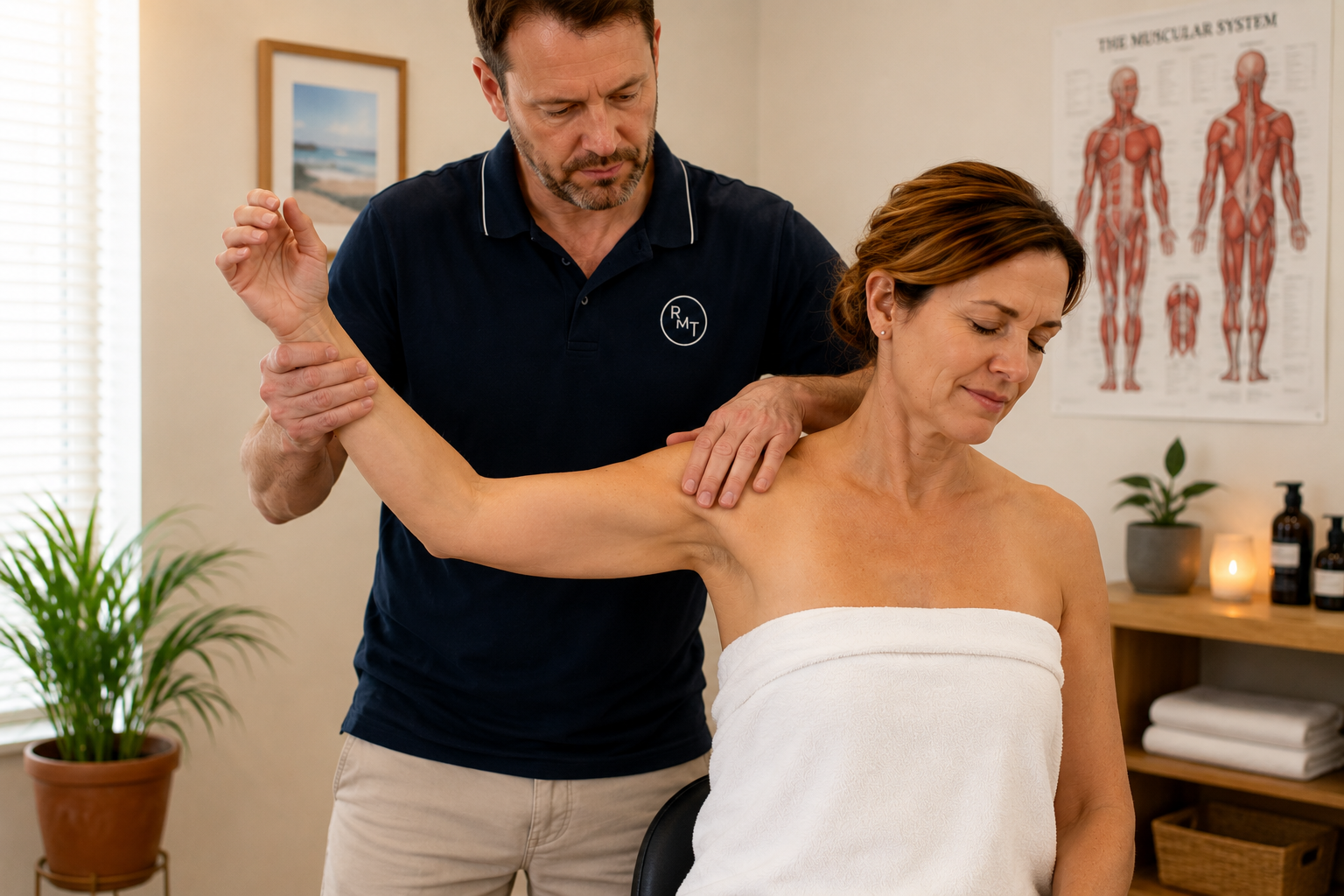
Not all massage techniques are appropriate for a frozen shoulder — particularly in the early painful stage.
🔹 Myofascial release — slow, sustained pressure applied to the fascial layer around the shoulder girdle. Helps reduce the pull on restricted tissue without aggravating the joint itself.
🔹 Trigger point therapy — the rotator cuff muscles, pectorals, and subscapularis commonly develop trigger points during frozen shoulder. Releasing these reduces referred pain and improves the shoulder’s resting position.
🔹 Deep tissue massage — applied to the upper back, neck, and posterior shoulder to release the compensatory tension that builds as the body adjusts to restricted movement. Deep tissue massage is particularly effective for the chronic muscle tightness that surrounds the affected joint.
🔹 IASTM therapy — instrument-assisted soft tissue mobilisation can be applied around the shoulder joint and along the fascial lines of the arm and upper back. Particularly useful in the thawing phase when tissue mobility is beginning to return.
⚠️ Direct, aggressive pressure over the joint itself is not appropriate during the freezing stage.
Pain should never be forced through in a frozen shoulder session.
A Real Scenario: A Shepparton Teacher With Frozen Shoulder
Picture a primary school teacher in her mid-forties.
She first noticed the ache when reaching up to write on the whiteboard.
She assumed it was a strained muscle and waited for it to pass.
Three months later, she couldn’t lift her arm above shoulder height.
Getting her cardigan on in the morning had become a ten-minute ordeal.
Her neck and upper back were constantly tense — the result of her body compensating on every movement.
By the time she sought treatment, she was in the frozen stage.
Massage didn’t unlock her shoulder overnight.
But within four sessions, her neck pain and upper back tension had significantly reduced.
She could sleep through the night without waking from shoulder discomfort.
Her overall pain levels dropped — which made the gentle mobility exercises her GP recommended far easier to perform.
That’s what massage does in frozen shoulder.
It doesn’t replace medical management.
It makes the rest of the recovery process more tolerable — and often faster.

What to Pair With Massage for Best Results
Massage works best as part of a broader approach to frozen shoulder recovery.
✔ Gentle range of motion exercises — prescribed by a GP or physiotherapist. These should never be forced. The goal is to prevent further capsule contraction, not to power through pain.
✔ Heat application — a warm pack on the shoulder before massage can help the surrounding tissue respond more readily to treatment.
✔ Consistent treatment frequency — irregular sessions produce slower results. Fortnightly massage during active stages keeps the compensatory tension from re-establishing.
✔ Mobile massage — for people whose shoulder pain makes driving difficult, having a therapist come to the home removes a genuine barrier. No parking, no reaching for a seatbelt, no aggravation before the session even starts.
👉 If the affected shoulder also disrupts sleep — which is extremely common — massage for sleep may be worth incorporating to support nervous system recovery alongside shoulder treatment.
What People Get Wrong About Frozen Shoulder
❌ “I just need to push through the stiffness.”
Forcing movement in the freezing stage increases inflammation and can prolong the condition significantly.
❌ “Rest will fix it.”
Complete rest allows the capsule to contract further. Gentle movement and treatment are both necessary.
❌ “Massage will be too painful.”
A skilled therapist doesn’t work on the joint directly. They work the surrounding tissue — which is often relieving, not painful.
❌ “It’ll go away on its own eventually.”
It can. But untreated frozen shoulder can take two to three years to resolve. Appropriate treatment compresses that timeline considerably.
Is Massage Right for Your Stage?
Here’s a simple guide:
✔ Freezing stage — yes, with gentle technique. Focus on neck, upper back, and shoulder girdle. Avoid direct joint pressure.
✔ Frozen stage — yes, more confidently. Compensatory tension is often severe. Myofascial and trigger point work both indicated.
✔ Thawing stage — yes, and this is often where the most visible progress occurs. Tissue is responding again. IASTM and deeper work become more appropriate.
👉 Always inform your therapist of your stage and your current pain levels before the session begins.

Recovery Takes Time — But You Don’t Have to Wait It Out Alone
Frozen shoulder is a slow condition.
There’s no shortcut through it.
But there’s a significant difference between waiting it out and actively supporting your body through the process.
Massage Shepparton treatments won’t dissolve the capsular adhesions.
But they will reduce your pain, release your compensatory tension, improve your sleep, and give your nervous system the space it needs to stop bracing.
That’s not a small thing — especially when you’re facing months of recovery.
👉 Explore the full range of treatments at Relaxellent Shepparton and find the right approach for where your shoulder is right now.