It starts as a dull ache.
Maybe in the lower back. Maybe deep in the glute.
Then one day it shoots down your leg.
You’re told it’s sciatica. Or a hip flexor problem. Or just “tight hips.”
You stretch. You rest. You try a foam roller.
It eases for a day or two — then returns.
Sound familiar?
What most people don’t realise is that tight hips, sciatic pain, and lower back tension are rarely separate issues.
They’re part of the same pattern. The same chain of connected tension that builds quietly — and then makes itself known in ways that stop you mid-step.
Locals managing this exact pattern are finding real relief through targeted massage Shepparton treatments that address the chain — not just the symptoms.
Here’s what’s actually happening in your body.

Why Tight Hips and Lower Back Pain Are Almost Always Connected
Your hips and lower back share more than just proximity.
They share load.
The lumbar spine, pelvis, and hip joint form a single mechanical unit.
When one part of that unit is restricted, the others compensate.
Tight hip flexors — the psoas, iliacus, and rectus femoris — pull the pelvis into an anterior tilt.
That tilt increases the curve in the lower back.
The lumbar muscles work harder to maintain balance.
Over time, they fatigue. They develop trigger points. They become a source of daily aching.
👉 You feel the pain in your lower back. But the pull is coming from the front of your hip.
This is one of the most common mismatches in musculoskeletal pain — and one of the most frequently missed.
What Sciatica Actually Is — and What It Isn’t
The word “sciatica” gets used loosely.
Technically, true sciatica means the sciatic nerve is being compressed or irritated somewhere along its path.
The sciatic nerve is the longest nerve in the body.
It exits the lumbar spine, travels through the pelvis, passes through or near the piriformis muscle in the deep glute, and runs down the back of the leg to the foot.
Compression or irritation anywhere along that path can produce:
- Sharp, shooting pain down the back of the leg
- Burning or tingling sensations
- Numbness in the leg, calf, or foot
- Deep aching in the glute that feels like it’s “inside” the hip
⚠️ Not all sciatic-type pain comes from a disc issue.
A significant proportion comes from piriformis syndrome — where the piriformis muscle in the deep glute compresses the sciatic nerve directly.
This is a muscular problem. Not a spinal one.
And it responds very well to targeted soft tissue treatment.
The Piriformis: The Muscle Nobody Talks About
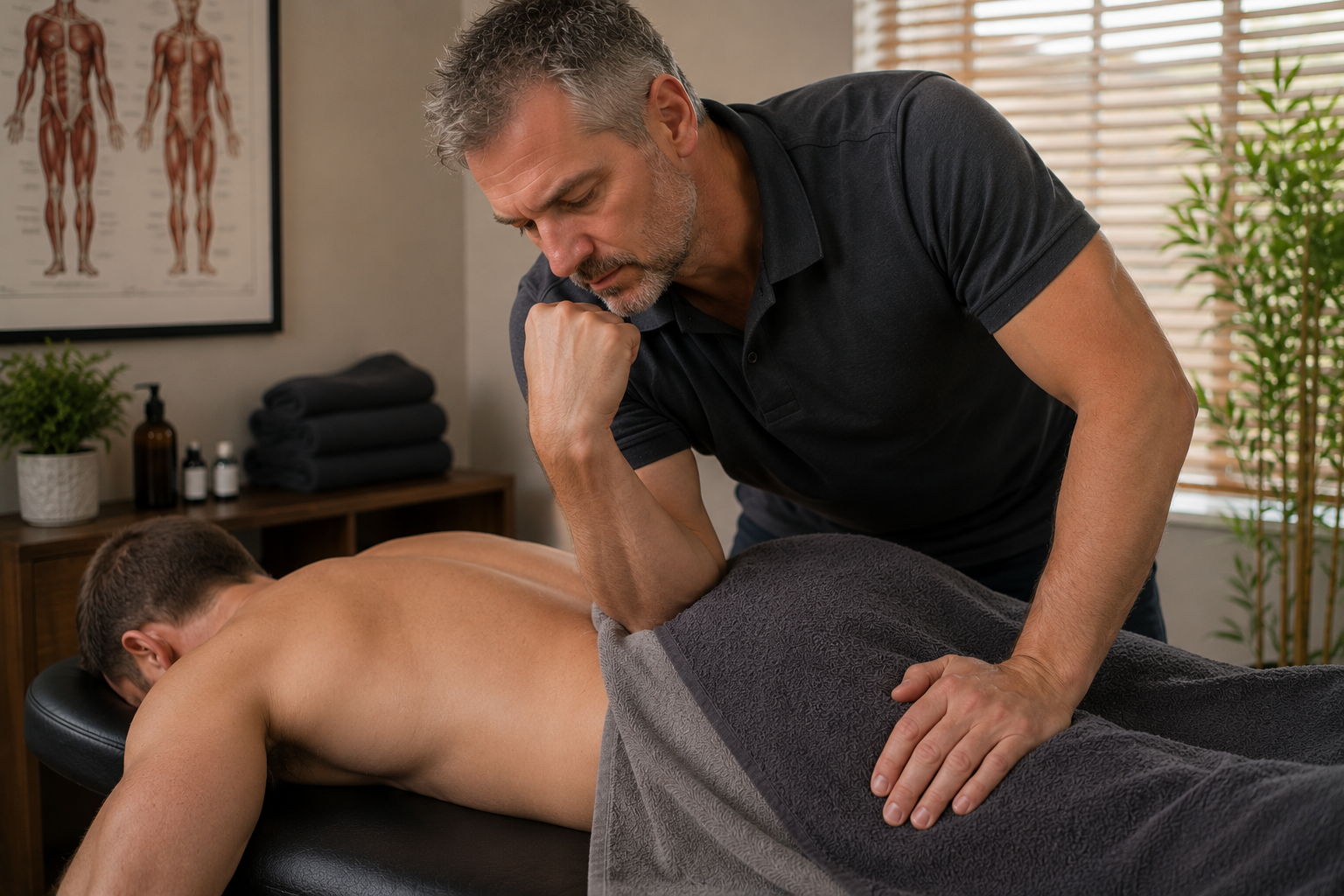
The piriformis is a small, deep muscle sitting beneath the gluteal muscles.
Its job is to externally rotate the hip.
When it becomes hypertonic — chronically overcontracted — it can press directly onto the sciatic nerve.
The result is pain that mimics a disc herniation.
Many people undergo extensive spinal investigation for pain that originates in this one small muscle.
🔹 Prolonged sitting is the most common trigger.
When you sit, the piriformis is compressed and held in a shortened position.
Hours of this, day after day, produces a muscle that is perpetually tight and increasingly reactive.
🔹 Compensatory tightening also occurs when the glutes aren’t firing properly.
When the primary gluteal muscles are inhibited — as they commonly are in sedentary people — the piriformis picks up the stability load they’re supposed to carry.
It’s asked to do a job far beyond its capacity. It responds with chronic tightness.
👉 Deep tissue massage targeting the piriformis and deep hip rotators can produce rapid, significant change in sciatic symptoms — particularly when the nerve compression is muscular rather than structural.
The Full Chain: From Hip Flexors to Hamstrings
Tension in this region rarely stays in one place.
It travels.
The hip flexors shorten. The pelvis tilts forward. The lower back overloads.
The glutes inhibit. The hamstrings tighten to compensate for gluteal weakness.
The piriformis braces. The IT band stiffens.
Every link in the chain responds to the one beside it.
⚠️ This is why treating only the lower back — or only the glute — produces temporary relief at best.
The pattern will simply re-establish itself because the other contributing structures haven’t changed.
A full-chain assessment looks at:
✔ Hip flexor length and tightness (psoas, iliacus) ✔ Gluteal strength and activation ✔ Piriformis tone and sciatic nerve involvement ✔ Hamstring tension and pelvic positioning ✔ Lumbar muscle holding patterns
Each of these informs the others. Each needs attention for lasting change.

Real Scenario: A Shepparton Driver With Chronic Glute and Leg Pain
Picture a long-haul delivery driver based in the Shepparton region.
Hours behind the wheel every day. Minimal walking. Long stretches of sustained hip flexion.
He’s had deep glute pain for about 18 months.
Sometimes it shoots into the back of his thigh. Sometimes the whole left leg feels heavy and numb by the end of a shift.
He’s been told it’s sciatica. He’s been given exercises. They help a little.
But nothing has lasted.
What hasn’t been addressed: his piriformis is chronically compressed from hours of sitting. His psoas is shortened from sustained hip flexion. His glutes have switched off almost entirely — leaving the piriformis to do their stabilising work.
All three are contributing simultaneously.
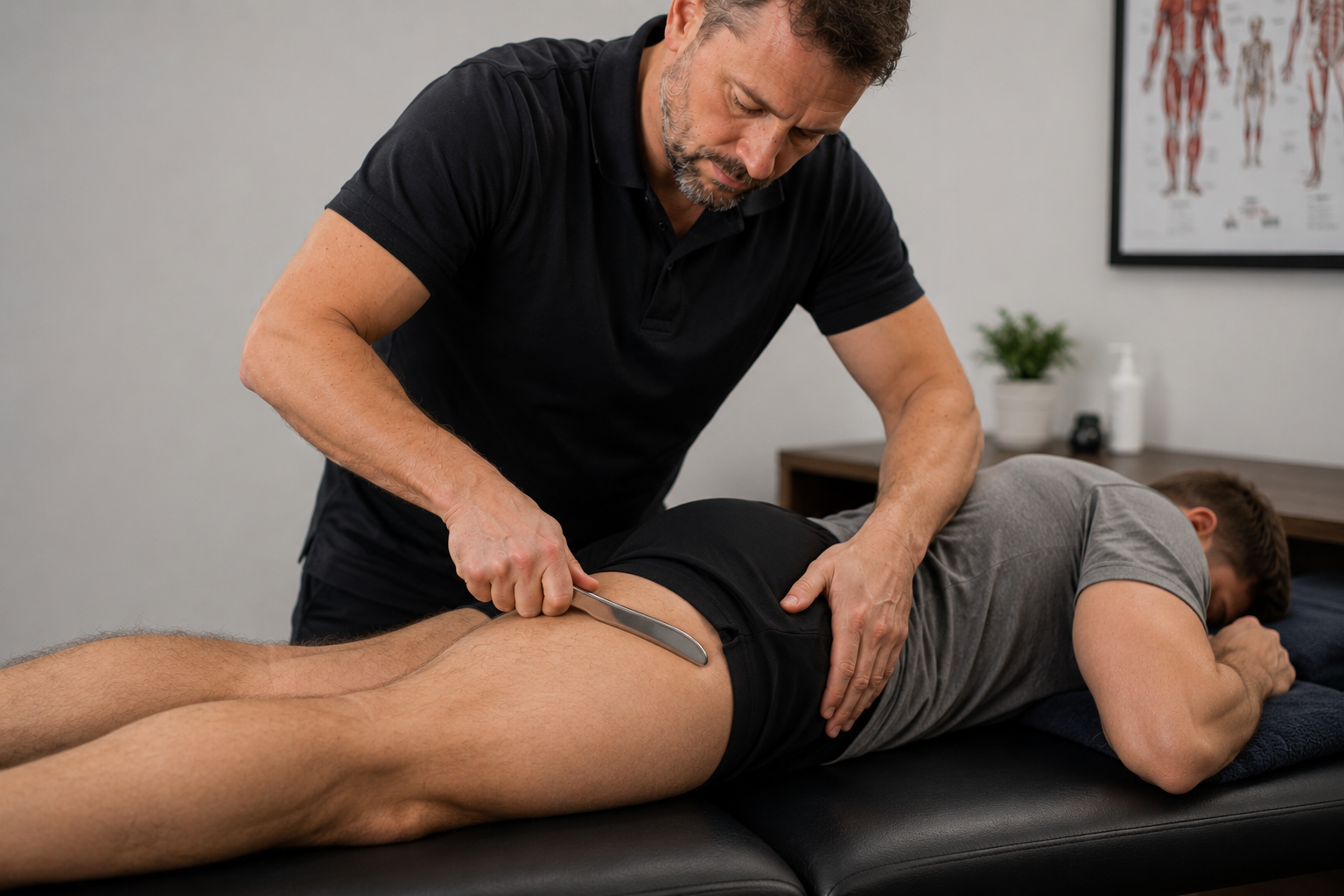
IASTM therapy combined with deep soft tissue work to the hip complex begins breaking down the fascial restrictions in the deep glute that have built up over 18 months.
Within a series of sessions, the shooting pain reduces significantly.
Not because the spine changed — because the tissue creating the nerve compression finally did.
Why Stretching Alone Doesn’t Break This Pattern
Stretching gets recommended for tight hips constantly.
And it has value. Maintained range of motion matters.
But stretching a muscle that is adherent to surrounding fascia, embedded with trigger points, and neurologically wired to stay contracted produces limited results.
❌ You can stretch a piriformis daily and still have sciatic symptoms if the fascial restriction hasn’t been addressed.
❌ You can stretch your hip flexors every morning and still have an anteriorly tilted pelvis if the psoas hasn’t been manually released.
❌ You can foam roll your IT band for months and still have lateral hip tightness if the tensor fasciae latae hasn’t been properly treated.
Stretching works best as a maintenance tool — after the tissue has been released.
It preserves what hands-on treatment gains.
It rarely replaces it.
What Massage Shepparton Treatment Looks Like for This Pattern
A thorough treatment approach for tight hips, sciatica, and lower back tension covers several interconnected areas.
🔹 Psoas and iliacus release — these deep hip flexors run from the lumbar spine to the lesser trochanter of the femur. Releasing them directly reduces anterior pelvic tilt and the lumbar loading that follows.
🔹 Piriformis and deep hip rotator work — slow, sustained pressure into the deep gluteal region releases the compression on the sciatic nerve. This is often where people feel the most immediate and tangible change.
🔹 Gluteal activation support — restoring tone and responsiveness to the glute medius and maximus removes the compensatory load being carried by the piriformis.
🔹 Hamstring and posterior chain release — tight hamstrings maintain the pelvic imbalance. Releasing them is part of restoring proper pelvic positioning.
🔹 Lumbar muscle treatment — the overloaded erector spinae and quadratus lumborum need direct treatment once the primary drivers have been addressed — otherwise they remain sensitised.
For complex presentations that have been building for months, a two-hour session allows enough time to work through the full chain without rushing any layer.
And for people whose hip and back tension is also disrupting sleep — which it commonly does — massage for sleep can be incorporated to address the nervous system component alongside the structural work.
Practical Steps While You’re Between Sessions
Treatment creates change. Habits between sessions protect it.
✔ Avoid prolonged sitting without breaks. Every 45–60 minutes, stand and move for five minutes. Even brief movement interrupts the piriformis compression cycle.
✔ Sleep position matters. Side sleepers with tight hips often benefit from a pillow between the knees. This prevents the top hip from dropping and rotating inward — which compresses the piriformis overnight.
✔ Strengthen the glutes. Bridges and clamshells are simple, low-impact exercises that restore gluteal firing. A therapist can guide you on timing these alongside treatment.
✔ Don’t ignore referral symptoms. If the leg pain, tingling, or numbness intensifies, worsens with specific movements, or spreads further down the leg — see a medical professional to rule out structural nerve involvement.
✔ Book before it peaks. Most people with this pattern book when the pain becomes unbearable. Consistent mobile massage Shepparton — on a regular schedule — prevents the pattern from reaching that threshold.
Your Lower Back Isn’t the Whole Story
Lower back pain, tight hips, and sciatic symptoms are almost never isolated problems.
They’re a chain — and every link matters.
Treating the pain without addressing what’s pulling on the structure beneath it is like treating smoke without the fire.
Massage Shepparton treatments that work across the full hip-pelvis-lumbar chain produce results that outlast any single-site approach.
The tension can be released. The pattern can be broken. The pain doesn’t have to be permanent.
👉 Explore the full range of treatments at Relaxellent Shepparton and find out what’s actually behind your lower back and hip pain.