You’ve stretched. You’ve rested. You’ve tried heat packs.
Maybe you’ve even had a massage or two.
And yet — the upper back pain comes back.
Every time. Like clockwork.
It eases for a few days. Then it’s there again. That dull, heavy ache between the shoulder blades. The tightness that climbs into the neck. The sense that something just won’t let go.
If this sounds familiar, you’re not dealing with bad luck.
You’re dealing with a pattern that hasn’t been addressed at its source.
Locals across Shepparton are finding real answers through targeted massage Shepparton treatments — not because massage is a miracle cure, but because it addresses what’s actually driving the return of upper back pain.
Here’s what that looks like.

Why Upper Back Pain Is So Stubborn
The upper back — technically the thoracic spine and surrounding musculature — is one of the most commonly affected areas in people with desk jobs, physically demanding work, or sustained stress.
But it’s also one of the most misunderstood.
Most people treat the pain where they feel it.
They roll a ball between their shoulder blades. They stretch their arms across their chest. They reach for the heat pack.
And it helps — briefly.
👉 Here’s the problem: the upper back is rarely where the problem starts.
It’s where the problem lands.
The real drivers are usually above and below the thoracic region — and until those are addressed, the upper back will keep compensating, keep overloading, and keep hurting.
The Real Drivers of Recurring Upper Back Pain
Understanding these changes everything.
Driver 1: Forward Head Posture
When the head sits forward of the shoulders — which happens in nearly every desk worker, phone user, and driver — the weight on the cervical spine increases dramatically.
The muscles of the upper back work overtime to counterbalance that forward load.
They fatigue. They develop trigger points. They refer pain between the shoulder blades.
The upper back feels like the problem.
But the head position is the cause.
Driver 2: Rounded Shoulders
Tight chest muscles pull the shoulders inward and forward.
This stretches and weakens the rhomboids and mid-trapezius — the muscles responsible for holding the shoulder blades in their correct position.
Overstretched, weakened muscles ache constantly.
They can’t rest because their resting length has been compromised.
No amount of rolling the upper back releases a chest that’s chronically tight.
Driver 3: Restricted Thoracic Mobility
The thoracic spine is designed to rotate and extend.
In people who sit for long periods, it stiffens significantly.
When thoracic mobility is restricted, the neck and lumbar spine compensate — taking on movement they weren’t designed to absorb.
This creates pain above and below — but the stiff thoracic region is the silent contributor going unaddressed.
Driver 4: Breathing Pattern Dysfunction
Shallow chest breathing — extremely common in stressed, desk-bound people — overloads the scalenes and upper trapezius muscles.
These are accessory breathing muscles. They’re designed for emergency use, not all-day activation.
When they work constantly, they tire. They refer pain into the upper back and shoulders.
⚠️ Most people don’t realise their breathing pattern is contributing to their upper back pain. But it frequently is.
What Keeps Happening When Only the Symptom Is Treated
This is the cycle most people are stuck in.
Pain appears → treatment eases the pain → underlying driver continues → pain returns.
Each time the pain returns, it may be slightly more established.
The tissue becomes more chronically adapted. The trigger points become more embedded. The postural holding pattern deepens.
❌ Stretching the upper back without releasing the pectorals doesn’t fix rounded shoulders.
❌ Massaging the rhomboids without addressing forward head posture doesn’t stop the upper back from overloading.
❌ Using heat to ease pain without treating the thoracic stiffness driving compensation doesn’t break the cycle.
Breaking the cycle requires identifying which drivers are active — and treating them directly.
How Targeted Massage Shepparton Treatment Addresses the Root Cause
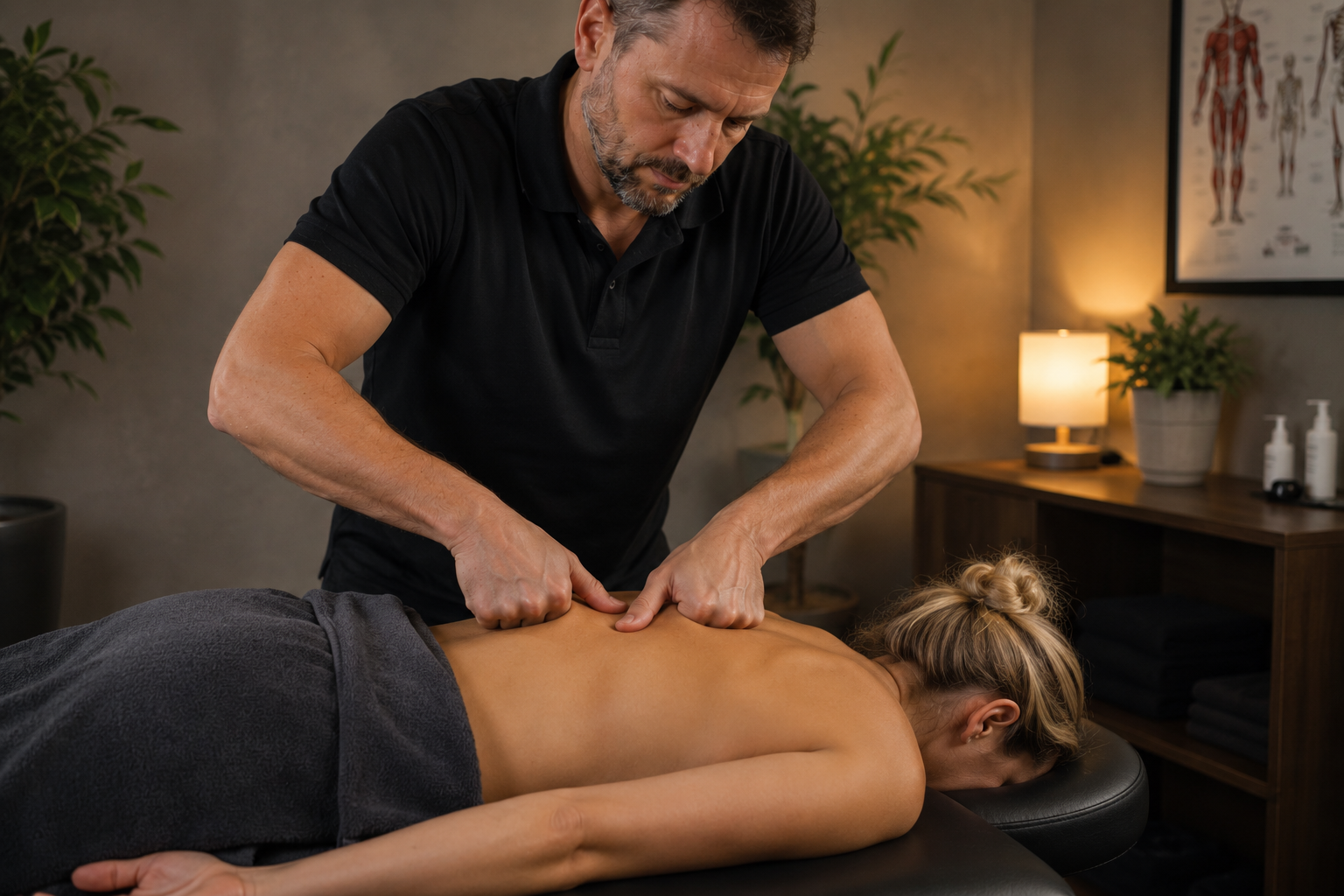
A skilled therapist doesn’t just work where it hurts.
They assess what’s contributing.
For upper back pain, that typically means working across multiple interconnected areas — not just the zone of complaint.
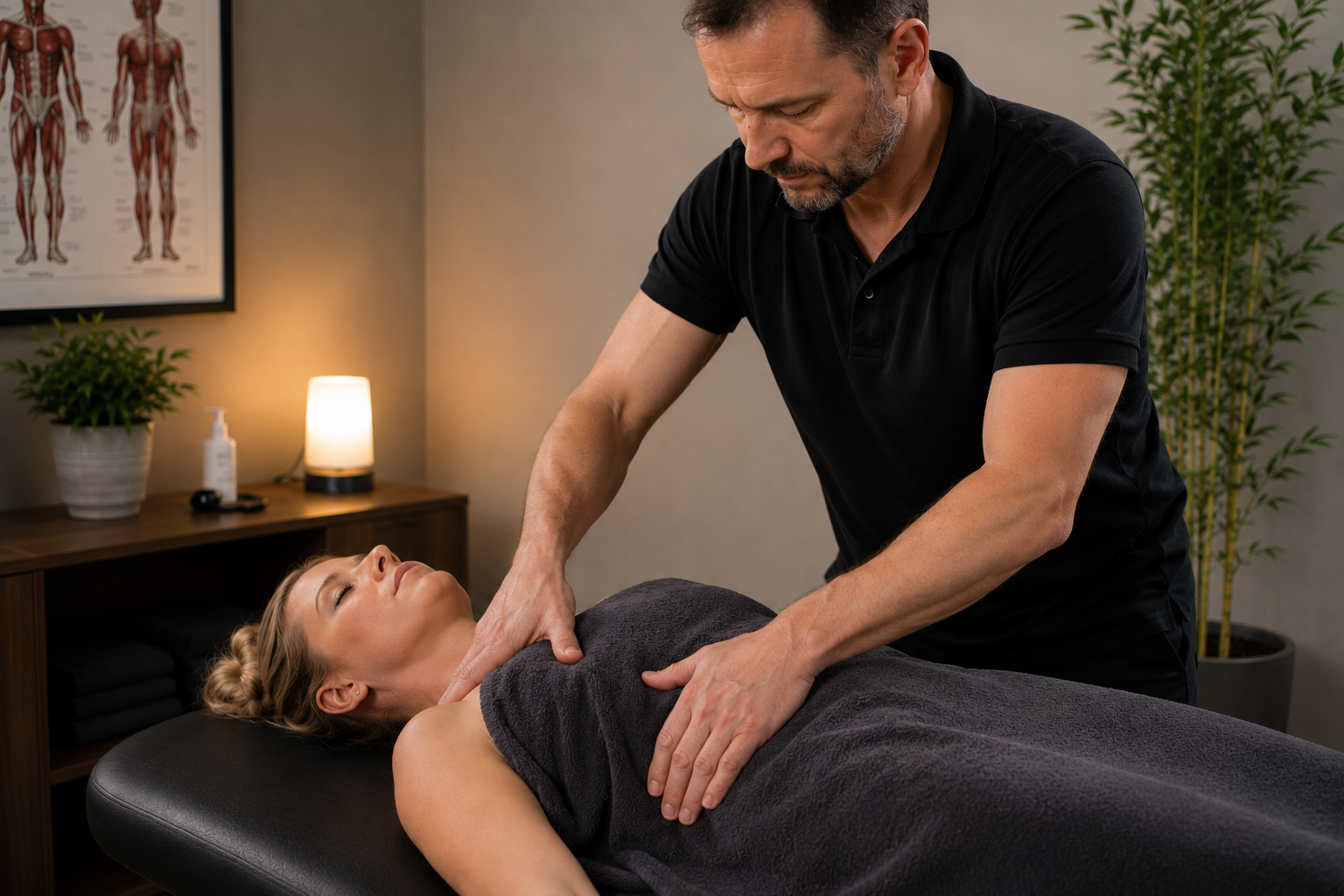
🔹 Pectoral and anterior shoulder release — loosening the chest muscles that are pulling the shoulders forward. Without this, the upper back stays under tension regardless of how much work is done on it directly.
🔹 Deep cervical and suboccipital work — addressing the neck muscles that are overloading from forward head posture. Deep tissue massage reaches the deeper layers of the cervical musculature that surface work doesn’t touch.
🔹 Thoracic mobilisation through massage — softening the paraspinal muscles along the thoracic spine to allow better segmental movement. This is often where people feel the most immediate and dramatic improvement.
🔹 Trigger point treatment in the rhomboids and mid-trap — these muscles develop embedded trigger points that refer pain across the upper back and into the neck. Releasing them removes a significant source of persistent aching.
🔹 IASTM for fascial restriction — when upper back tension has been present for months, the fascia becomes involved. IASTM therapy uses precision instruments to address the connective tissue layer that manual massage alone often can’t fully reach.
Real Scenario: A Shepparton Teacher Who Tried Everything
Consider a primary school teacher in their mid-thirties.
On their feet all day. Writing on boards. Looking down at student work. Carrying bags between rooms.
They’ve had upper back pain between the shoulder blades for two years.
They’ve tried yoga. They’ve tried a standing desk. They’ve tried general relaxation massage.
Everything helps for a day or two. Then the pain returns.
What hasn’t been addressed: their pectorals are chronically shortened from years of reaching forward. Their neck is carrying a load that’s compressing the upper thoracic segments. Their breathing pattern shifted to chest-dominant during a high-stress period and never corrected.
Three connected drivers. None of them sitting between the shoulder blades.
Once all three are treated — in the right sequence, across multiple sessions — the upper back stops compensating. The pain pattern breaks.
This is not an unusual case.
It’s the standard picture for upper back pain that keeps returning.

Practical Steps for Shepparton Locals Managing Upper Back Pain
Beyond treatment sessions, there are things that either help or hinder recovery.
✔ Check your screen position. If you’re looking down at a laptop, your neck is loading forward all day. Raise the screen to eye level.
✔ Address the chest, not just the back. Doorway stretches and chest openers help maintain what massage gains in the pectoral region.
✔ Notice your breathing. Place a hand on your belly. If it doesn’t move when you breathe, your chest is doing all the work.
✔ Book consistently, not reactively. Treating upper back pain only when it becomes unbearable means you’re always catching up. Regular mobile massage sessions — without the barrier of travel — make consistency realistic.
✔ Allow enough treatment time. Upper back pain with multiple contributing drivers often needs more than a 60-minute session to address properly. A two-hour massage allows the thorough, unhurried treatment that complex patterns require.
For people whose upper back tension is also contributing to frequent headaches — which it often does through trigger point referral — migraine ease massage addresses the head-neck-upper back chain as a connected system.
The Shift From Managing Pain to Resolving It
Most people with recurring upper back pain have accepted it as a permanent feature.
They manage flare-ups. They work around it. They assume this is just how their body is now.
It doesn’t have to be.
Upper back pain that keeps returning is a signal — not a life sentence.
It’s your body asking for the right kind of attention at the right layer.
Massage Shepparton treatments, when properly targeted and consistently applied, create real change in the tissue patterns driving that signal.
Not just relief. Resolution.
👉 Browse the full range of treatments at Relaxellent Shepparton — and find the approach that finally addresses what’s been driving your upper back pain all along.