You haven’t lifted anything heavy.
You haven’t had an accident.
You haven’t done anything that should cause this much pain.
And yet — your neck aches. Your lower back is stiff. Your wrists feel tight. Your eyes are strained by 2pm.
Sound familiar?
If you work at a desk in Shepparton, your job is quietly building tension in your body every single day.
Massage Shepparton treatments are helping office workers reverse these patterns — before they become something harder to fix.
Here’s what’s actually happening inside your body when you sit — and why it matters.

The Hidden Problem With Sitting All Day
Sitting feels passive. It isn’t.
When you sit at a desk, your body works constantly.
It’s holding a position it was never designed to sustain for hours at a time.
Your hip flexors shorten. Your glutes go dormant.
Your lumbar spine loses its natural curve and begins to round.
Your head drifts forward — often by 5 to 10 centimetres — as your eyes reach toward the screen.
👉 For every centimetre your head moves forward, the effective load on your cervical spine increases significantly.
A head that normally weighs around 5kg can place 15–20kg of pressure on the neck and upper back when projected forward.
Your muscles work overtime just to keep your head upright.
They never switch off.
They never recover.
And after months and years in that position — the pattern becomes structural.

Why “Sitting Up Straight” Doesn’t Actually Fix It
Most desk workers have been told to sit up straight.
It’s good advice. But it doesn’t address what’s already happened to the tissue.
When muscles have been shortened or lengthened for months, they don’t just reset because you adjusted your chair.
The tissue has adapted.
Shortened muscles stay short. Weakened muscles stay weak.
Postural correction matters — but it works best alongside hands-on treatment that addresses the existing structural changes.
⚠️ Trying to correct poor posture without releasing tight tissue first is like trying to straighten a bent nail without heat.
You can force it — but you’re working against the structure, not with it.
The Five Tension Patterns Desk Workers Develop Over Time
These aren’t random. They follow predictable paths.
1. Forward Head Posture
The head drifts forward. The deep neck flexors weaken.
The suboccipital muscles at the base of the skull tighten dramatically.
This is the direct cause of most desk-related headaches.
It also compresses the cervical discs and can contribute to nerve irritation down the arms.
2. Rounded Shoulders
The pectorals and anterior deltoids shorten from reaching forward to the keyboard.
The mid-back muscles — rhomboids and lower trapezius — become chronically overstretched and weak.
The result is a rounded, hunched posture that continues even when you’re not at a desk.
3. Tight Hip Flexors
Sitting keeps the hip flexors in a permanently shortened position.
When you stand, they pull the pelvis forward — increasing lumbar curve and loading the lower back.
This is one of the leading contributors to lower back pain in sedentary workers.
4. Weak, Inactive Glutes
Glutes are designed to stabilise the pelvis and absorb force through the lower limb.
Sitting switches them off.
The lower back compensates — and takes load it was never meant to carry alone.
5. Wrist and Forearm Tension
Sustained keyboard and mouse use creates repetitive strain in the wrist flexors and forearm muscles.
Left untreated, this contributes to conditions like carpal tunnel syndrome and lateral epicondylitis.
What Massage Shepparton Does for Each of These Patterns
Each pattern has a corresponding treatment approach.
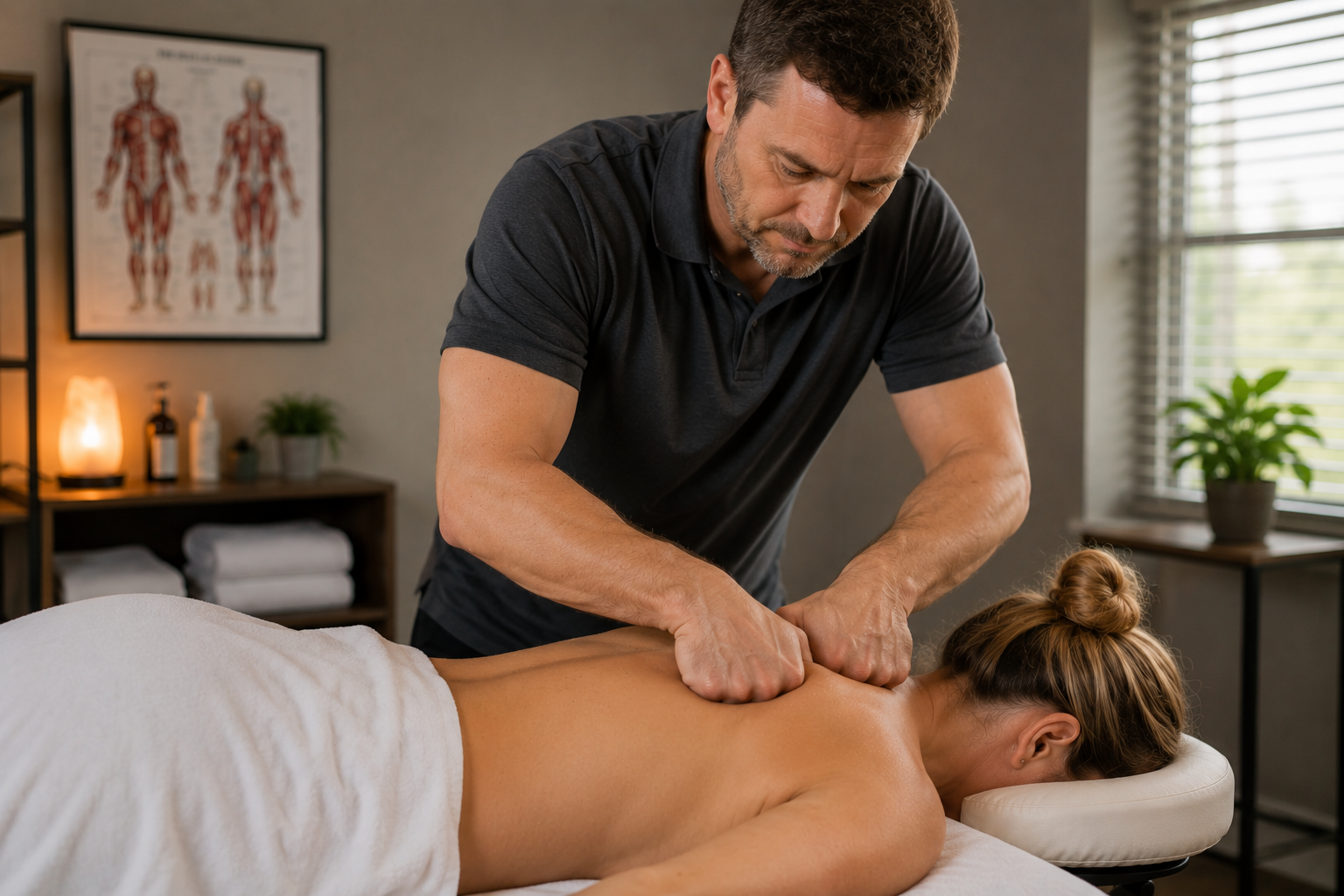
🔹 Forward head posture and neck pain — Deep tissue massage releases the suboccipital muscles, upper trapezius, and levator scapulae. These are the primary drivers of desk-related neck pain and headaches. For people whose headaches are frequent or severe, migraine ease massage targets the specific structures contributing to referred head pain.
🔹 Rounded shoulders and upper back pain — Targeted pectoral release combined with mid-back work helps rebalance the pull across the shoulder girdle. Over a series of sessions, the resting position of the shoulders noticeably improves.
🔹 Hip flexor tightness and lower back pain — Releasing the psoas, iliacus, and rectus femoris removes the forward pull on the pelvis. This alone can produce significant and lasting relief in the lower back — without a single stretch needing to be taught.
🔹 Glute inhibition and pelvic instability — Once hip flexors release, targeted glute activation work — sometimes combined with massage — helps restore the muscle firing patterns that protect the lower back.
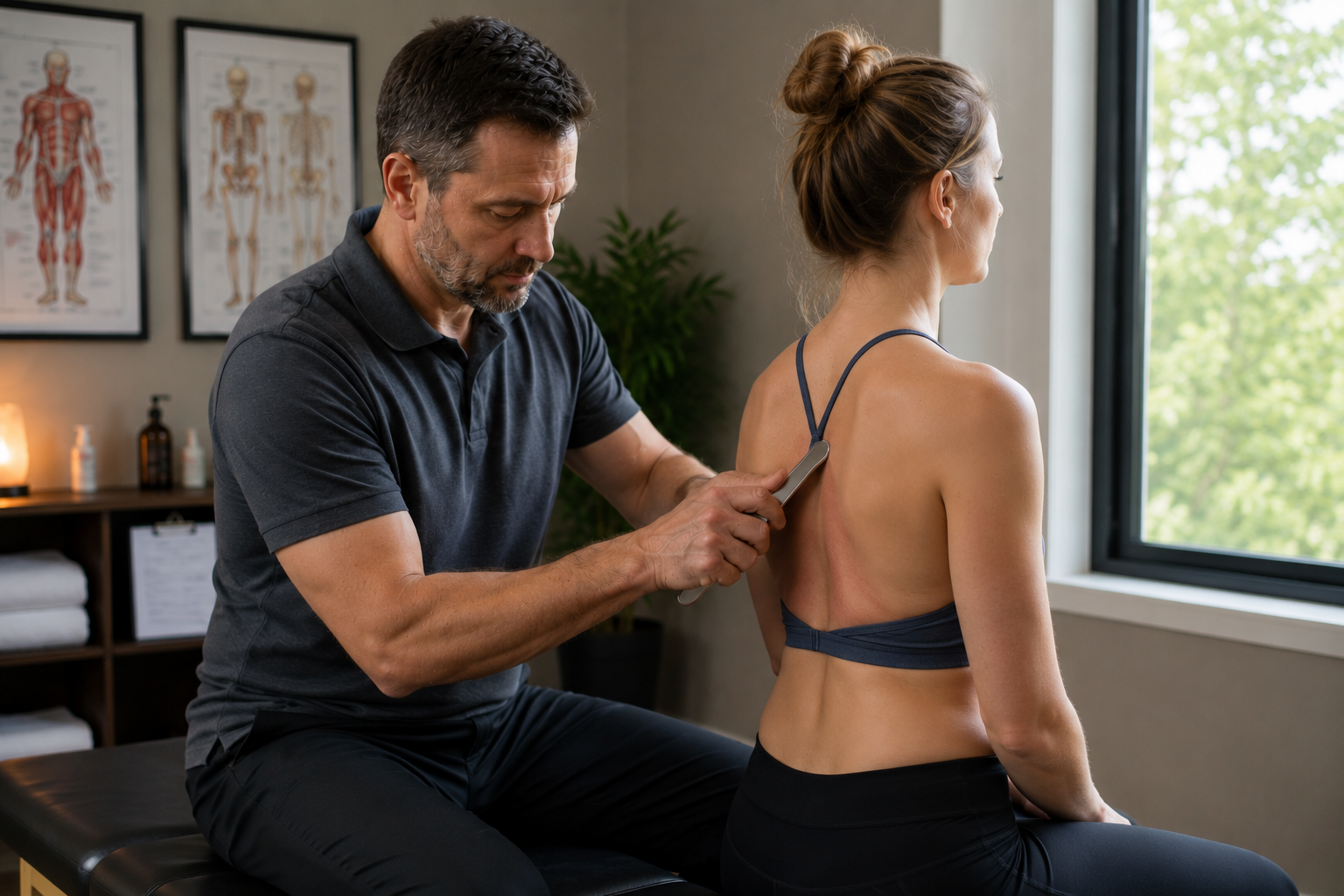
🔹 Wrist and forearm repetitive strain — IASTM therapy is particularly effective here. The instrument-assisted technique breaks down adhesions in the forearm flexors and around the wrist with a level of precision that manual massage alone can’t achieve.
A Real Scenario: A Shepparton Admin Worker, Five Years Into the Role
Picture someone who joined a local government office in their mid-twenties.
They were fine for the first year or two.
By year three, they started noticing tightness in the neck most evenings.
By year five, they had a constant dull ache between the shoulder blades.
Tension headaches two or three times a week.
Lower back pain every time they stood up after sitting for a while.
Nothing acute had happened.
The tension had simply accumulated — millimetre by millimetre — until it crossed a threshold into daily pain.
This is not unusual. It’s the standard trajectory for untreated desk worker tension.
The good news?
It responds well to treatment — especially when addressed before the structural changes become severe.
Why Desk Workers in Shepparton Keep Putting It Off
There are a few common reasons people in this situation delay getting help.
❌ “It’s not that bad yet.”
By the time it feels urgent, the pattern is significantly more established.
Early treatment is always easier — and faster — than late treatment.
❌ “I’ll stretch more.”
Stretching helps maintain range of motion.
It doesn’t release chronically hypertonic muscle or restore fascial mobility.
It’s a maintenance tool, not a correction tool.
❌ “I don’t have time to get to a clinic.”
This is a genuine barrier — which is exactly why mobile massage Shepparton exists.
A therapist comes to your home. You don’t lose an hour to travel. You go straight from the table to the couch.
For people who work long hours and find evenings are their only realistic window, late-night massage is available — so timing isn’t the obstacle it might seem.
How Often Should Office Workers Book Massage Shepparton?
Frequency depends on how much tension has accumulated and how demanding your work week is.
As a general guide:
✔ Active tension buildup (daily desk work, 8+ hours) — once every two to three weeks produces the most consistent results.
✔ Maintenance phase (tension under control) — once a month keeps the patterns from re-establishing.
✔ High-stress periods (deadlines, long hours, disrupted sleep) — more frequent sessions prevent the sharp accumulation that leads to injury.
👉 A two-hour session works well for desk workers who want to address multiple areas in one visit — neck, upper back, lower back, and forearms — without feeling like any area was rushed.
What to Do Between Sessions
Massage creates change. Your habits between sessions determine whether it holds.
✔ Set a screen timer. Stand and move for five minutes every hour. Not for fitness — for tissue circulation.
✔ Check your screen height. If you’re looking down, your neck is constantly loading forward.
✔ Relax your jaw deliberately throughout the day. Most desk workers clench without realising.
✔ Roll your shoulders back and down — not as a posture fix, but as a way of noticing how far they’ve crept up.
✔ Stay hydrated. Muscles that are dehydrated hold tension longer and are slower to release after treatment.
✔ Notice your breathing. Shallow, chest-based breathing keeps the upper trapezius engaged. Slow, diaphragmatic breathing helps it release.
These aren’t a replacement for treatment. They’re what makes treatment last longer between sessions.
Your Desk Isn’t Going Anywhere — But Your Pain Can
Most Shepparton office workers accept tension as an occupational fact.
It’s not.
It’s a pattern that builds because it’s never interrupted.
Massage Shepparton interrupts it.
It resets the tissue. It restores circulation. It gives the nervous system a chance to stop bracing.
And when done regularly — it changes the baseline your body operates from.
Better posture. Less neck pain and shoulder pain. A lower back that doesn’t protest every time you stand up.
You don’t have to choose between your career and your physical health.
You just need a strategy that works alongside your schedule.
👉 Explore the full range of treatments at Relaxellent Shepparton and find the right approach for the tension your desk has built up.