You wake up with a headache.
You take something for it. It eases. It comes back tomorrow.
Meanwhile, your neck has been stiff for weeks.
You’re treating them as two separate problems.
But there’s a strong chance they’re not.
Neck pain and headaches share a common origin far more often than people realise.
And until that origin is addressed, both will keep returning — regardless of how many pain relievers you take.
Across Shepparton, massage Shepparton therapists regularly work with clients who’ve been managing these two symptoms independently for months, not knowing they’re looking at the same structural pattern from two different angles.
Here’s what’s actually going on.
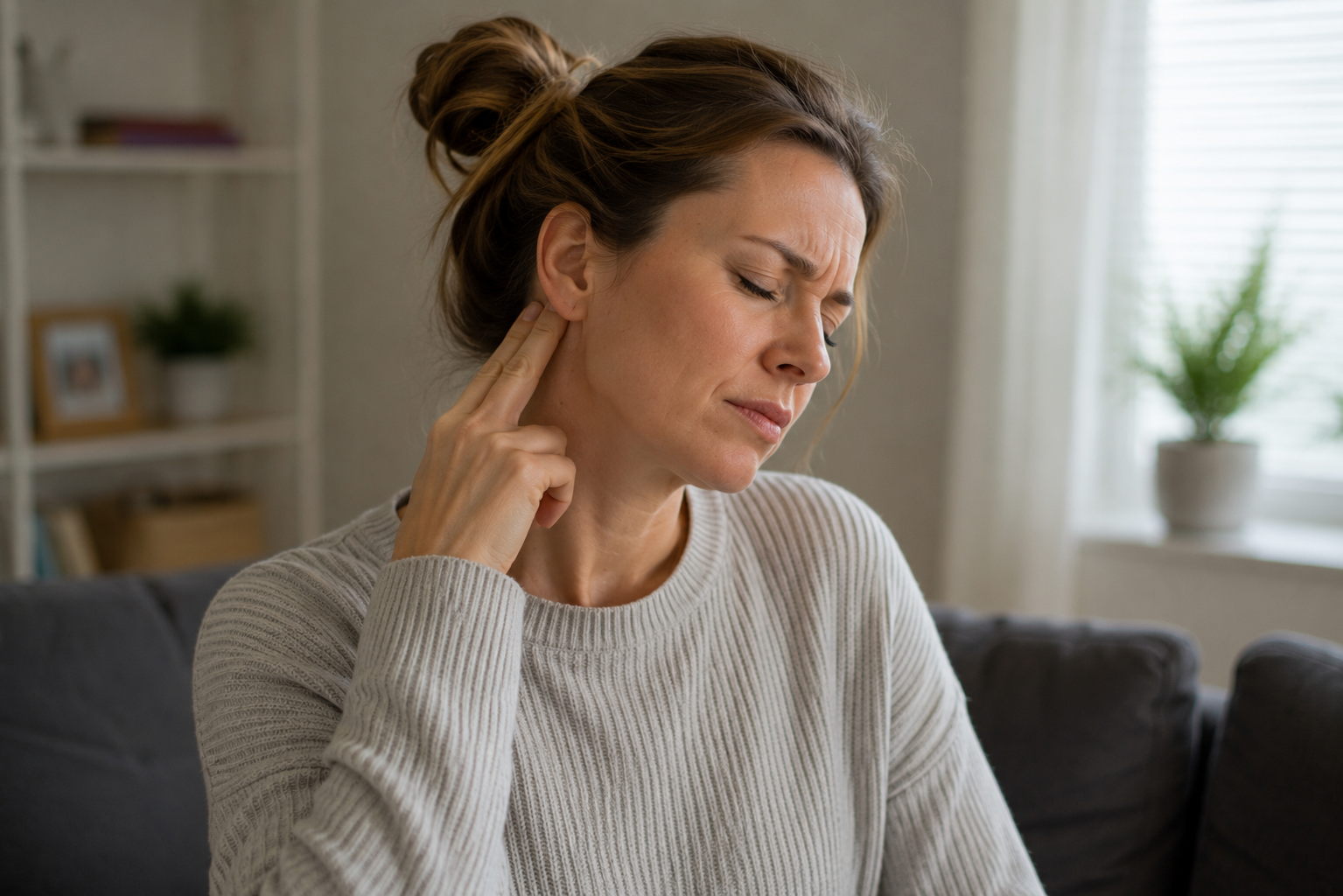
The Cervicogenic Connection Most People Miss
The term is cervicogenic headache.
It means a headache that originates in the cervical spine — the neck — not in the brain, the sinuses, or hormonal fluctuations.
The upper cervical joints, particularly C1, C2, and C3, share nerve pathways with the trigeminal nerve — the nerve responsible for sensation across the face, forehead, and scalp.
When the upper cervical structures are irritated, compressed, or restricted, pain signals travel along these shared pathways.
The brain interprets them as head pain.
👉 You feel it above the eyebrows, behind the eyes, or across the forehead.
But the source is at the base of your skull — or in the muscles and joints of your upper neck.
⚠️ This is why taking pain medication for a cervicogenic headache produces only temporary relief.
You’re treating the signal, not the structure generating it.
The Suboccipital Muscles: Where Neck Pain Meets Head Pain
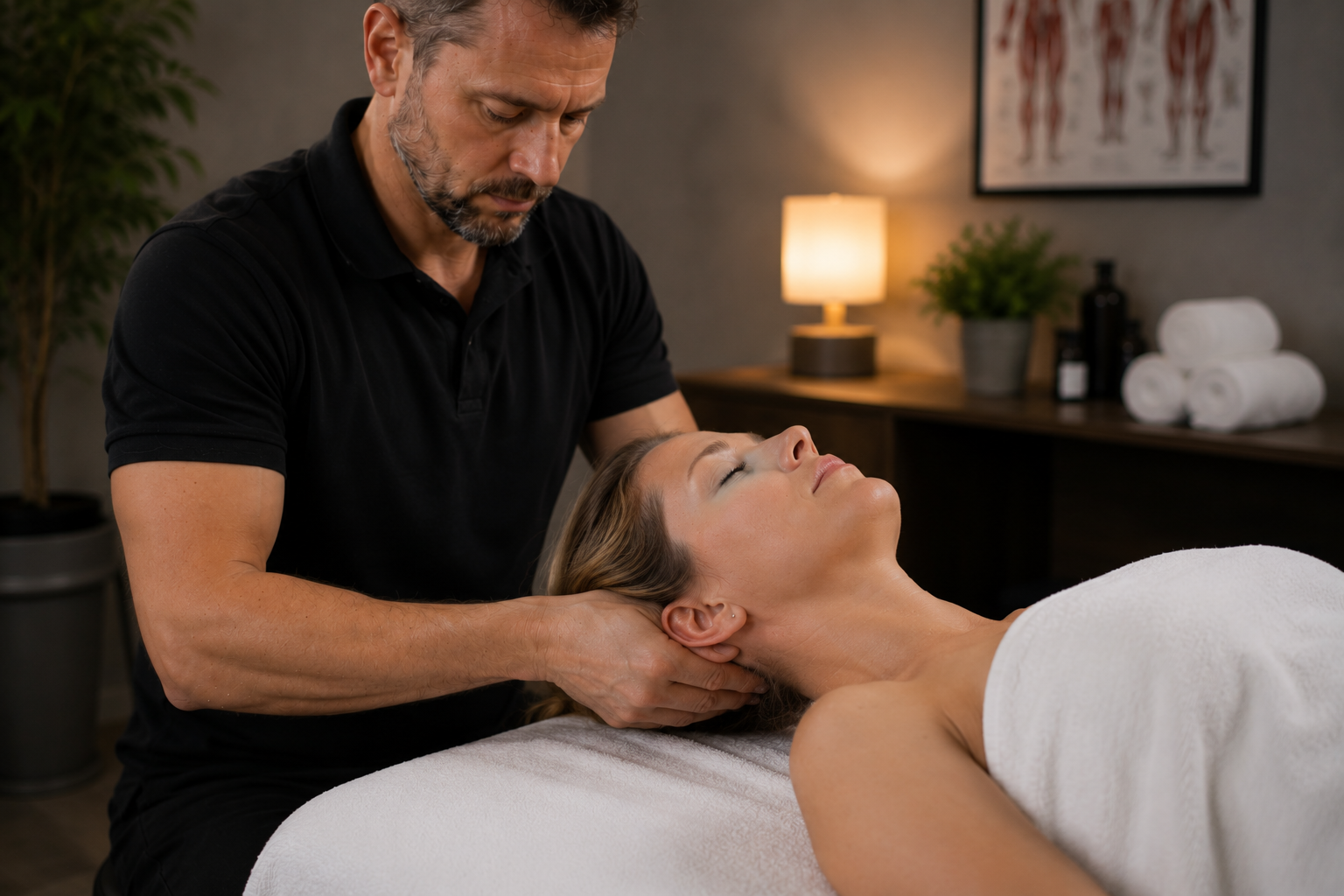
At the base of your skull sits a group of four small muscles called the suboccipitals.
Their job is to make the fine positional adjustments of the head — tilting, rotating, and extending the skull on the atlas.
They are packed with proprioceptors — sensory receptors that feed constant positional information to the brain.
They are also one of the most consistently overloaded muscle groups in people who use screens, drive frequently, or carry sustained postural tension.
When the suboccipitals become hypertonic — which happens quickly under load — they do several things simultaneously:
🔹 They compress the greater occipital nerve, which runs directly through the suboccipital muscle group on its way to the scalp. This produces a headache that starts at the base of the skull and radiates upward over the top of the head.
🔹 They restrict movement at the atlanto-occipital joint, producing neck stiffness and a feeling of “locked” rotation first thing in the morning.
🔹 They refer pain into the eye socket — creating that familiar dull pressure behind the eye that often gets misattributed to eye strain or screen use.
All three symptoms. One muscle group. One treatment area.
Forward Head Posture: The Postural Driver Behind Both
Neither the suboccipitals nor the upper cervical joints develop these problems randomly.
There is almost always a postural driver beneath them.
Forward head posture is the most common.
For every centimetre the head moves forward of the neutral position, the effective load on the cervical spine increases substantially.
A head that weighs 5kg in neutral can impose 15–20kg of effective load when it projects forward by just a few centimetres.
The suboccipitals brace. The upper trapezius braces. The levator scapulae braces.
All of them work overtime — every waking hour — to keep the head from falling further forward.
They fatigue. They develop trigger points. They compress the nerves that produce headaches.
And they never get to rest — because the forward head position never corrects itself without deliberate intervention.
❌ Sitting up straight occasionally doesn’t fix forward head posture.
The tissue has already adapted to the forward position. Telling yourself to sit straighter is fighting structure with intention — and intention loses that battle every time.
The Upper Trapezius Trigger Point Pattern
The upper trapezius deserves specific attention.
It is one of the most common trigger point locations in the human body — and one of the most consistent contributors to tension headaches.
Active trigger points in the upper trapezius refer pain in a very specific pattern: up the back and side of the neck, wrapping around the ear, and into the temple region.
👉 This is frequently mistaken for a migraine — particularly when it occurs unilaterally (one side only).
The pattern is muscular in origin. The trigger point can be palpated directly.
And it responds significantly to targeted treatment.
Deep tissue massage combined with sustained trigger point pressure into the upper trapezius — and its synergists — produces rapid, meaningful reduction in both neck pain and referred headache symptoms for most clients.

Levator Scapulae: The Overlooked Contributor
Running from the upper cervical spine to the superior angle of the shoulder blade, the levator scapulae is a muscle that rarely gets enough attention in headache discussions.
When chronically tight — which it commonly becomes in anyone who sits with rounded shoulders — it pulls the cervical spine into rotation and side flexion.
This compresses the facet joints on one side of the neck.
It contributes directly to the stiff, one-sided neck that many people wake up with.
And its trigger points refer pain up the side of the neck to the base of the skull — feeding directly into the cervicogenic headache pattern.
🔹 The levator scapulae is treated differently from the trapezius.
It requires specific positioning and depth of pressure that a general massage rarely achieves.
Targeted remedial work — particularly in the angle between the neck and the top of the shoulder blade — is where the most significant change is made.
Real Scenario: A Shepparton Healthcare Worker With Daily Headaches
Picture a nurse in their late 30s.
Long shifts. Constantly looking down at patients, charts, and medication trays.
They’ve had a daily dull headache across the forehead and behind the left eye for about six months.
They also have a persistent stiff neck — worse in the morning — and a feeling that their left shoulder is consistently higher than the right.
They’ve seen their GP. Their eyes have been checked. Sinuses are clear.
No cause found.
What hasn’t been examined: the upper cervical joints are restricted. The left suboccipitals are hypertonic and compressing the greater occipital nerve. The left levator scapulae has an active trigger point referring into the base of the skull. The left upper trapezius has a trigger point radiating into the temple.
All of this is addressable through targeted soft tissue treatment.
Migraine ease massage is specifically designed for this presentation — working through the neck, suboccipital region, and upper shoulder as a connected system rather than treating the headache in isolation.
Within four to six sessions, the daily headache pattern typically reduces significantly in both frequency and intensity.
Why Medication Alone Keeps the Cycle Running
Pain medication has genuine value for acute pain management.
But for cervicogenic headaches driven by structural neck tension, it creates a problematic cycle.
The headache is suppressed chemically. The underlying muscle tension and joint restriction remains unchanged.
The headache returns. More medication is taken.
Over time, frequent analgesic use can itself contribute to medication overuse headache — a rebound phenomenon where the headache worsens as medication wears off.
⚠️ If you’re taking pain relief for headaches more than two or three times per week, the structural cause needs addressing — not just the symptom.

What Effective Treatment for This Pattern Looks Like
A thorough approach works across the connected chain — not just the site of pain.
✔ Suboccipital release — slow, sustained decompression of the muscles at the base of the skull. Clients frequently notice a change in headache sensation during this work as the nerve compression eases.
✔ Upper cervical joint mobilisation through massage — gentle sustained techniques that encourage movement through C1–C3, where restriction most commonly develops.
✔ Upper trapezius trigger point treatment — systematic identification and release of the trigger points contributing to referred temple and forehead pain.
✔ Levator scapulae work — targeted release in the angle between neck and shoulder blade, addressing the pull on the cervical spine from below.
✔ Pectoral and anterior shoulder release — addressing the rounded shoulder posture that loads the levator scapulae and trapezius from the front.
For clients managing this pattern with a busy schedule that makes clinic visits difficult, mobile massage brings the same quality of targeted treatment directly to the home — removing the travel barrier that often causes people to delay or skip sessions.
And for those who want to address the full upper body pattern in a single unhurried session, a two-hour massage provides the time needed to work through every contributing structure properly.
Practical Steps You Can Take Between Sessions
Treatment does the heavy lifting. But daily habits determine how quickly the pattern breaks.
✔ Raise your screen. If you’re looking down at a laptop, your suboccipitals are loading every minute you work. Eye-level screens are non-negotiable for this pattern.
✔ Check your phone position. Looking down at a phone for extended periods compresses the upper cervical structures directly. Hold it higher — or limit extended use.
✔ Chin tucks. A simple exercise: gently draw the chin backward (creating a double chin). This resets the head position and gently stretches the suboccipitals. Ten repetitions, several times daily.
✔ Sleep position. A pillow that keeps the cervical spine in neutral alignment overnight prevents the suboccipitals from being compressed for eight hours. If you’re waking with neck pain, your pillow height is worth reviewing.
✔ Track your headache pattern. Note when they occur, how long they last, and where exactly the pain sits. This information is genuinely useful for your therapist in identifying which structures are most active.
Two Symptoms. One Pattern. One Solution.
Neck pain and headaches that occur together are almost never coincidental.
They’re two faces of the same structural imbalance — one presenting in the cervical spine, one presenting in the head.
Treating them together, through a single targeted approach, produces results that treating each separately rarely achieves.
Massage Shepparton treatments that address the full cervico-cranial chain give your body what it actually needs — not just management of the symptoms, but resolution of the structure creating them.
👉 Explore the full treatment range at Relaxellent Shepparton and take the first step toward days that don’t start with a headache.